
 Sep 15,2026
You need a plastic cup thermoforming machine. The market offers options from $15,000 entry-level units to fully automated lines exceeding $500,000. Suppliers quote different cycle speeds, forming areas, and energy ratings. How do you separate genuine capability from marketing promises?
The answer lies in understanding what actually drives production economics: not the highest cycle speed on a spec sheet, but the total daily output your machine will realistically deliver, the energy it consumes per cup, and how quickly you can switch between products. This guide presents five practical tips—each focused on a decision factor that directly impacts your profitability, not the supplier's commission.To understand the fundamental architecture differences that affect every selection decision, explore Sinoplast's plastic thermoforming machine series overview.
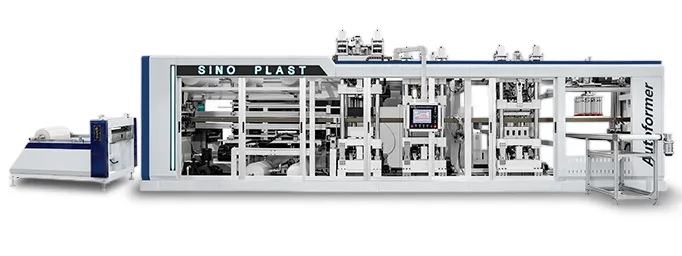
Suppliers love to quote cycle speed. “Our machine runs at 45 cycles per minute.” It sounds impressive. But cycle speed alone tells you almost nothing about your actual production capacity.
The formula that matters is:
Total Daily Output = Cycle Speed (CPM) × Cavities per Mold × Operating Hours × Efficiency Factor
A machine with a small forming area might fit a 10-cavity mold. At 40 CPM, that's 400 cups per minute—24,000 cups per hour. A machine with a larger forming area might fit a 24-cavity mold. At 30 CPM, that's 720 cups per minute—43,200 cups per hour. The “slower” machine produces 80% more output.
Industry data confirms this variability. High-end machines like Kiefel's KTR 6.2 Speed can reach 45 cycles per minute and produce up to 86,000 cups per hour with large molds. At the other end, entry-level models may produce only 2,000 to 6,000 cups per hour depending on cup size and material.
What to ask: “What is the maximum forming area? How many cavities can fit for my specific cup diameter? What is the realistic daily output at 85% efficiency?”
How to judge: Request a cavity layout drawing for your cup dimensions. Multiply cavities by the machine's rated CPM at 80-85% efficiency to get a realistic daily output estimate. Don't accept a cycle speed number without the cavity count.
If you produce cups from a single material, this tip is simple. But most cup manufacturers run at least two materials—PP for hot-fill and PET for cold drinks, or PS for general use and PLA for compostable lines.
Each material demands different machine capabilities:
| Material | Key Machine Requirement | Forming Temperature |
|---|---|---|
| PP | Extended oven length; narrow forming window requires precise zone control | 160-180°C |
| PET | Pre-drying system; precise cooling to avoid crystallization | 120-160°C |
| PS | Standard configuration generally sufficient | 120-160°C |
| PLA | Lower oven temperatures; dedicated heating profile | 100-140°C |
The critical question is not whether the machine “can” run a material, but whether it can run that material at full production speed with acceptable scrap rates.
What to ask: “Can you provide a material compatibility matrix? Can you demonstrate a test run with my specific material and cup design?”
How to judge: Request sample runs with your actual material and cup design. A machine that runs PET beautifully may struggle with PP's narrower forming window without an extended oven. Retrofitting this later is expensive—and sometimes impossible.
The purchase price difference between a servo-driven machine and a traditional hydraulic machine can be $20,000 to $50,000. That gap feels significant. But it often disappears within the first year of operation.
According to the IndexBox United States Thermoforming Equipment Market report, servo-electric and hybrid machines consume 20–35% less energy than hydraulic systems, directly reshaping total-cost-of-ownership calculations for buyers.
Here's the practical math: A mid-range hydraulic machine might consume 120 kW/h during operation. A servo equivalent might consume 75-85 kW/h. At $0.10/kWh, running 20 hours per day, that's a difference of $7,200 to $9,000 per year. Over a five-year machine lifespan, the servo machine saves $36,000 to $45,000 in electricity alone—more than covering the upfront premium.
What to ask: “What is the actual power consumption in kW during steady-state production? What is the air consumption? What is the rated power versus used power?”
How to judge: Request the “used power” figure, not the “rated power.” Ask for a breakdown: heating power, motor power, and auxiliary power. Calculate annual electricity cost based on your local rates and expected operating hours.
If you produce one cup size day after day, changeover speed barely matters. But if you run multiple cup sizes or serve multiple customers with different packaging requirements, changeover time directly impacts your capacity utilization.
Industry data shows changeover times range from 30 minutes to several hours depending on automation level. Machines with recipe storage can store temperature profiles and forming parameters for each mold, reducing setup time significantly. Quick-change clamping systems can bring changeovers down to 10-15 minutes for proficient operators.
Consider a manufacturer producing three cup sizes daily. At 45-minute changeovers, they lose 2.25 hours of production time per day. At 15-minute changeovers, they lose only 45 minutes. Over a 300-day year, that's 450 hours of recovered production time—equivalent to adding nearly two months of capacity without buying a second machine.
What to ask: “Does this machine have recipe storage? How many recipes can it store? What is the actual changeover time from last good part to first good part?”
How to judge: Ask for a live demonstration or video of an actual changeover. Measure from the moment the previous run ends to the moment the first good part comes off the next run. Don't accept verbal estimates.
This is the mistake that catches first-time buyers: spending the entire budget on the forming machine and buying undersized auxiliary equipment.
Thermoforming is a battle against heat. The mold must cool rapidly between cycles to maintain production speed. If the water chiller cannot remove heat fast enough, the machine must slow down. An undersized air compressor creates similar constraints—insufficient pressure for plug assist or vacuum forming limits cycle time.
Industry guidance consistently recommends oversizing auxiliary equipment by at least 20%. The extra upfront cost is far less than the lost production from an undersized system. A chiller that costs $3,000 more but prevents a 15% speed reduction pays for itself within weeks.
What to ask: “What are the chiller BTU requirements at full production speed? What air pressure and flow rate does the machine require? What happens to cycle time if these are undersized?”
How to judge: Ask the supplier for a utility requirements sheet that specifies chiller capacity (in kW or BTU/h), compressed air consumption (m³/min), and required pressure (bar). Cross-check these against your facility's existing capacity before signing.
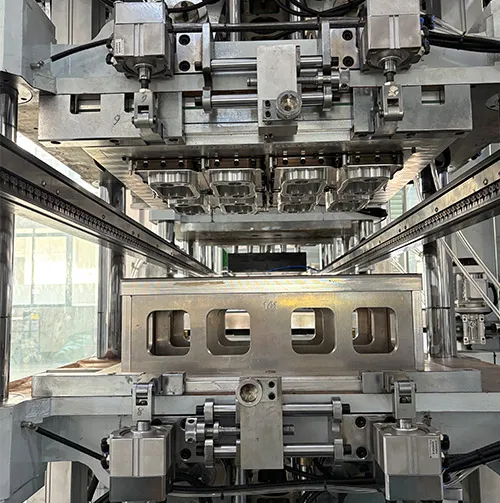
Scenario A: Startup entering the cup market
A new manufacturer plans to produce 50,000 cups per day for local beverage shops. They need a machine that handles PP and PET, produces 300 ml to 700 ml cups, and fits a limited budget. Their priorities: material flexibility, manageable upfront cost, and reasonable output. A mid-range multi-station machine with recipe storage and an oversized chiller would serve them better than a high-speed machine with undersized auxiliaries. Industry estimates suggest a payback period of 12-18 months for medium-volume lines.
Scenario B: Established converter expanding capacity
An existing manufacturer produces over 3 million cups per month. They need maximum throughput, energy efficiency, and fast changeovers to serve multiple clients. Their priorities: large forming area for maximum cavity count, servo drives for energy savings, and quick-change tooling. The higher upfront investment is justified by lower operating costs and the ability to capture more orders through faster changeovers.For a deeper look at how different machine architectures affect production flexibility and output, explore Sinoplast's application center for real-world production scenarios.
These five tips give you a framework for evaluating any plastic cup thermoforming machine—regardless of brand or price point. The key is to move beyond cycle speed and purchase price, and focus on the metrics that determine your actual production economics: daily output, energy cost per cup, changeover efficiency, and auxiliary system reliability.
Once you've clarified these decision factors—your target output, material mix, cup designs, and operating budget—comparing the specific capabilities of available equipment becomes the next logical step. You can review Sinoplast's thermoforming machine options for different production scenarios, or explore how upstream equipment like the PP/PS sheet extruder integrates with your cup forming line.
Prev:
null
Sep 01,2026
We are a professional plastic machinery provider in China.