
 Sep 01,2026
You're planning a new thermoforming line—or perhaps you're looking to expand an existing one. The machine selection is important, but there's an equally critical decision that comes first: which material will you run?
PET and PP dominate the thermoformed packaging industry. They're the go-to choices for cups, containers, lids, and trays across food packaging and beyond. Yet despite their widespread use, these two polymers behave very differently on the thermoforming machine. One demands precise drying and temperature control; the other tolerates broader operating windows but delivers different mechanical properties.
This guide examines the practical differences between PET and PP in thermoforming—from material properties and machine requirements to cycle times and end-use performance. By the end, you'll have a clear framework for deciding which material aligns with your production goals, product specifications, and operational constraints.
Understanding why PET and PP behave differently starts at the molecular level. These differences directly affect everything from heating requirements to final product performance.
PET (Polyethylene Terephthalate) is a semi-crystalline polyester valued for its exceptional clarity, stiffness, and barrier properties against gases and moisture. Its aromatic ring structure produces high tensile strength and outstanding oxygen barrier characteristics—roughly 3 to 5 times better than standard PP homopolymer. For food packaging, this translates into longer shelf life without additional barrier coatings. However, PET is hygroscopic and can absorb over 0.4% moisture within hours at ambient conditions. This moisture sensitivity is one of the most significant operational differences between the two materials.
PP (Polypropylene) is a non-polar polyolefin with a relatively high melting point between 160 and 170°C. It offers superior moisture barrier performance, resists attack from acids and alkalis, and has lower density than PET. PP is chemically inert and performs well across a broad temperature range, making it suitable for hot-fill products and microwave-safe packaging. Unlike PET, PP absorbs negligible moisture—typically below 0.02%. This single distinction eliminates a major capital expense on the PP side: dedicated drying equipment.
The optical difference is equally stark. PET offers crystal clarity, making it the default choice for retail-visible packaging where product presentation matters. PP is naturally translucent to opaque, which limits its appeal for applications requiring high transparency but works well for products where visibility isn't a priority.For a deeper understanding of how these materials perform in actual production, explore Sinoplast's application center for real-world case studies.
When you move from material properties to actual production, the differences become immediately practical. Here's how PET and PP compare across the critical machine parameters.
PP typically requires higher forming temperatures than PET. PP's forming temperature range is approximately 140-175°C, while PET typically forms at 130-160°C. This means the heating system must be capable of reaching and holding higher temperatures for PP production.
PET is more sensitive to temperature uniformity than PP, making consistent heating across the sheet width especially important for PET applications. PP requires careful heating management because it has a relatively narrow forming window. Heat too little and the material resists deep draws; heat too much and wall thickness distribution becomes uneven. The semi-crystalline structure of PP also means it tends to spring back slightly after forming, which must be accounted for in tool design.
This is perhaps the most significant operational difference. PET must be dried before processing. A dedicated dehumidifying dryer running at 140-160°C for 4-6 hours is non-negotiable for PET sheet production. Inadequate drying leads to hydrolytic degradation during heating, causing brittleness and surface defects in the finished product. For operations in humid regions, drying infrastructure for PET can add $15,000-$40,000 to the initial system cost.
PP requires no such investment. Simple hopper dryers or even ambient feeding suffice in most climates.
Cycle times differ between the two materials. In Sinoplast's equipment, the maximum forming speed for PET sheets reaches 45 cycles per minute, while PP sheets typically run at up to 30 cycles per minute. For stable, consistent production, many operators choose to run PP at approximately 20 cycles per minute and PET at 30 cycles per minute. This 25-50% speed advantage for PET reflects its stiffer forming behavior and faster cycle characteristics.
PET softens more gradually and offers a broader processing window for amorphous grades, giving operators more flexibility during forming. It's stiffer and more sensitive to temperature uniformity.
PP is more flexible and forgiving during forming but requires careful cooling management to achieve dimensional stability. Mold design, clamping force, and cooling channel configuration all need to accommodate these different characteristics when switching between materials.To see how Sinoplast's machines accommodate both materials, review the plastic thermoforming machine series and its multi-material capabilities.
| Parameter | PET | PP |
|---|---|---|
| Optical clarity | Crystal clear, excellent transparency | Translucent to opaque |
| Melting/forming temperature | Higher forming temperatures required | 160-170°C melting point, narrow forming window |
| Moisture sensitivity | Highly hygroscopic—requires drying (140-160°C, 4-6 hours) | Negligible absorption—no drying required |
| Oxygen barrier | 3-5× better than PP | Lower oxygen barrier |
| Moisture barrier | Moderate | Superior |
| Chemical resistance | Good | Excellent—resists acids, alkalis, solvents |
| Heat resistance | Deforms at ~70°C | Withstands up to 120°C (microwave-safe) |
| Typical cycle speed | Up to 40 molds/min | Up to 30 molds/min |
| Drying equipment cost | $15,000-$40,000 additional | None required |
| Best applications | Cold drink cups, fresh produce containers, retail-visible packaging | Hot-fill cups, microwaveable containers, dairy tubs, hot food trays |
Choosing between PET and PP isn't about which material is "better"—it's about which material fits your specific production requirements. Here's a step-by-step approach to making that decision.
Start with the end in mind. What does your finished product need to do?
Does it need to be crystal clear for retail display? Choose PET.
Will it be used for hot food or microwave reheating? Choose PP.
Does it need long shelf life with oxygen-sensitive contents? Choose PET.
Will it contact acidic or oily foods? Choose PP.
Do you have space and budget for drying equipment? If not, PP is the more practical choice.
What's your typical production volume? Higher volumes may justify the additional investment in PET drying infrastructure.
What's your facility's humidity level? In humid regions, PET drying becomes even more critical and costly.
If maximum output per shift is your priority, PET's faster cycle times (up to 40 molds/min vs. 30 molds/min for PP) offer a significant advantage.
If product depth or complex geometries require longer forming times, the speed advantage may diminish.
If you plan to run both materials on the same machine, ensure your machine has independently controlled heating zones, servo-driven forming stations, and parameter storage capabilities.
Modern machines with digital control systems can store material-specific parameter sets, making transitions significantly faster and more repeatable.
PET: Lower material cost in some regions, but requires drying equipment and higher energy consumption.
PP: Higher material cost in some cases, but lower capital investment and simpler operations.
For guidance on optimizing your thermoforming line for specific materials, visit Sinoplast's service page for technical support resources.
A manufacturer producing clear cups for cold drinks, smoothies, and iced beverages needs crystal clarity so customers can see the product inside. PET is the clear choice—it offers exceptional transparency, good barrier properties, and faster cycle speeds. The manufacturer must invest in drying equipment and train operators on proper material conditioning, but the end product justifies the additional complexity.
A manufacturer producing microwaveable meal trays and hot-fill soup containers needs heat resistance above all. PP withstands temperatures up to 120°C and is microwave-safe, making it the only viable choice among these two materials. The material's natural translucency isn't a drawback for this application, and the lack of drying requirements simplifies operations.
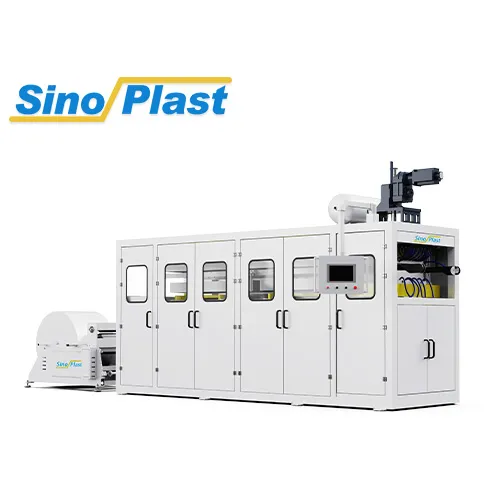
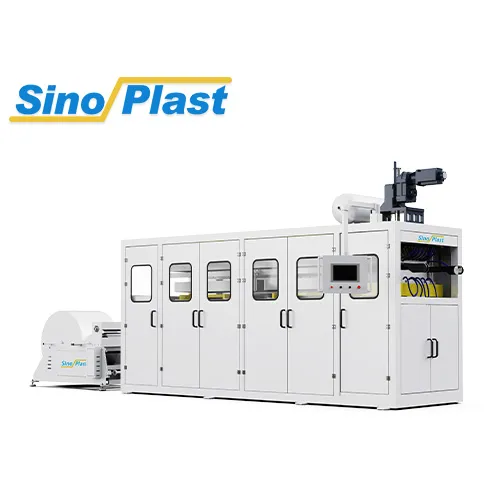
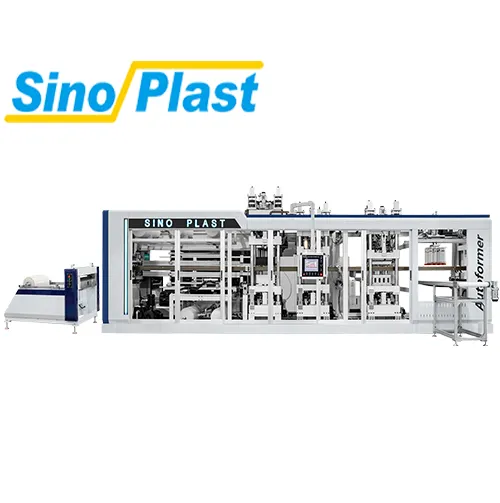
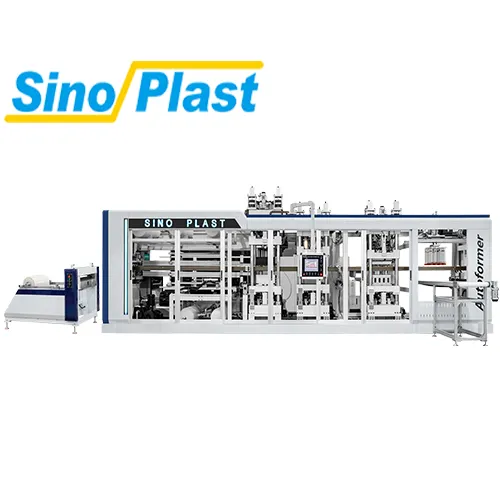
A contract packaging manufacturer produces both cold beverage cups (PET) and hot food containers (PP) for multiple clients. They need a machine that can handle both materials efficiently. The key is a thermoforming machine with independently controlled heating zones, servo-driven forming stations, and digital parameter storage. Sinoplast's multi-station thermoforming machines offer these capabilities, with parameter save functions that enable quick setup by simply recalling stored settings.

Once you've clarified these key decision factors—product requirements, operational capacity, and production volume—comparing the specific capabilities of available equipment becomes the next logical step. You can review Sinoplast's thermoforming machine options for high-speed PET production or high-volume PP applications, or explore how the PP/PS sheet extruder integrates with your downstream forming operations.
The material you choose will influence not just your machine configuration but also your upstream extrusion line, tooling design, and quality control procedures. Understanding these interconnections early in the planning process helps avoid costly retrofits and production delays down the line.For a deeper understanding of sheet extrusion fundamentals that apply to both PET and PP, see Sinoplast's PP/PS sheet extruder page for insights into extrusion parameters and material preparation.
How to Stop Flash on Your Plastic Thermoforming Machine for Good
5 Practical Strategies to Reduce Scrap Waste in Thermoforming
Why Undersized Auxiliaries Can Stop Your Thermoforming Line
This article is part of Sinoplast's technical content library. No direct sales or pricing information is included. All technical discussions aim to help you make informed purchasing decisions.
We are a professional plastic machinery provider in China.