
 Oct 09,2026
Food-contact thermoforming requires more than selecting a material that forms well. The material must comply with the regulations of every market where the finished product will be sold, and the production process must be documented to support that compliance. This guide covers the main regulatory frameworks, material selection criteria, specific requirements for rPET and PLA, and the documentation buyers should prepare before production begins.
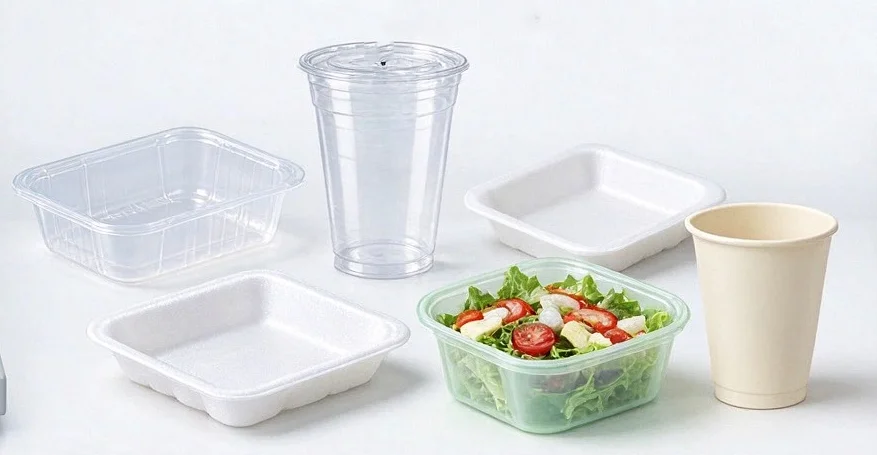
Thermoformed food packaging is regulated differently in each major market. Understanding which framework applies to your destination market is the first step in material selection.
| Market | Primary Regulation | Key Requirement |
|---|---|---|
| United States | FDA 21 CFR 177 | Materials must comply with applicable sections; Letter of Conformance may be requested |
| European Union | EU 10/2011 | Union List of authorized substances; overall migration limit (OML) 10 mg/dm²; specific migration limits (SML) for restricted substances |
| European Union (packaging) | EU PPWR (Regulation 2025/40) | Recycled content targets from 2030; PFAS ban in food-contact packaging; conformity assessment and EU Declaration of Conformity mandatory |
| China | GB 4806.7 | Total migration limit 10 mg/dm²; specific migration requirements for heavy metals and other substances |
Under EU 10/2011, plastic food-contact materials must be accompanied by a written Declaration of Conformity (DoC) in business-to-business trade, with supporting documentation available for inspection. The regulation establishes an overall migration limit of 10 milligrams per square decimeter of food-contact surface area, plus specific migration limits for individual substances.
The EU PPWR, which entered into force in February 2025, adds packaging-specific requirements on top of food-contact rules. From 2030, plastic packaging must contain minimum recycled content, and PFAS in food-contact packaging are banned.
For buyers exporting to multiple markets, the most restrictive applicable requirement typically determines the material and testing strategy.
The following table summarizes key characteristics for thermoforming material selection. Actual performance depends on sheet thickness, mold design, and processing conditions.
| Material | Heat Resistance | Clarity | Recyclability | Typical Food-Contact Applications |
|---|---|---|---|---|
| PP | Good (up to ~100°C) | Moderate | Widely recycled | Lunch boxes, trays, cups, lids |
| PET | Moderate (~70°C) | High | Widely recycled | Cold cups, fruit boxes, trays |
| PS | Moderate | High | Limited recycling infrastructure | Cups, lids, trays |
| rPET | Similar to virgin PET | Depends on quality | Supports recycled content targets | Trays, containers (not for microwave/oven use) |
| PLA | Lower (~50-60°C) | High | Industrially compostable | Cold food containers, cups |
PP is often selected for applications requiring heat resistance, such as lunch boxes that may hold warm food. PET offers high clarity for cold beverage cups and fruit packaging. PS provides clarity at lower cost but faces increasing regulatory pressure in some markets. rPET supports recycled content targets but requires verified food-grade sourcing and decontamination. PLA offers a compostable option for cold applications but requires careful temperature control during forming.
When evaluating materials for food-contact thermoforming, buyers should confirm that the specific grade is listed in the applicable positive list and that any additives or colorants are also authorized. The sheet extrusion process — including drying, extrusion temperature, and cooling — affects the final material properties and must be compatible with the intended thermoforming parameters.
Recycled PET (rPET) is increasingly important for food packaging as recycled content targets come into force. However, not all rPET is suitable for food-contact applications.
The critical step is decontamination. Post-consumer PET flakes must undergo a validated decontamination process that removes potential contaminants from previous use. EFSA evaluates recycling processes and issues opinions on their safety for food-contact applications. For example, the continuous reactor step in certain processes has been identified as the critical step determining decontamination efficiency.
Key processing considerations for rPET:
| Parameter | Consideration |
|---|---|
| Feedstock source | Must come from approved collection streams; colorless water and beverage bottles are typically preferred |
| Decontamination | Validated process required; cannot rely on conventional extrusion alone |
| Drying | rPET may require different drying conditions than virgin PET |
| IV (intrinsic viscosity) | Affects sheet strength and forming behavior |
| Migration testing | Required to confirm compliance with applicable limits |
| End-use restrictions | Thermoformed rPET trays are not intended for microwave or conventional oven use |
For sheet extrusion lines producing rPET sheet, the extrusion system must be configured to handle the specific drying and decontamination requirements. Review the available PP/PS sheet extruder configurations to discuss material compatibility with the Sinoplast team.

PLA (polylactic acid) offers a compostable alternative for cold food packaging. However, its processing window differs significantly from conventional thermoplastics.
Typical PLA thermoforming parameters:
PLA sheets may require pre-drying before thermoforming. The extruded sheet should be heated evenly before forming to avoid stress marks or incomplete forming. Aluminum molds are commonly used for PLA packaging containers.
For food-contact applications, the PLA grade must comply with applicable migration requirements. Compostability claims require certification according to recognized standards (e.g., EN 13432). Buyers should confirm that the specific PLA grade and any additives meet the food-contact regulations of the destination market.
The sheet extrusion process directly affects the quality and compliance of the final thermoformed product. Key parameters include:
| Parameter | Effect on Quality and Compliance |
|---|---|
| Drying | Moisture in PET and PLA can cause hydrolysis, reducing molecular weight and creating surface defects |
| Extrusion temperature | Affects melt homogeneity and sheet consistency |
| Cooling | Determines sheet crystallinity and subsequent forming behavior |
| Thickness control | Affects wall thickness distribution in the formed product |
| Additives | Must be food-contact approved; some processing aids are not permitted in food-contact applications |
For PP and PS, drying is typically less critical than for PET or PLA, but consistent sheet quality still depends on stable extrusion conditions. The sheet thickness tolerance should be appropriate for the forming depth and product requirements.
For PET and PLA, moisture control is critical. Inadequate drying can lead to reduced sheet quality and potential compliance issues if degradation products form during processing.
Buyers should request and verify the following documents before production begins:
Material documentation:
Regulatory documentation:
Supply chain documentation:
The compliance documentation should be maintained and available for inspection. Under EU rules, manufacturers, distributors, and importers of materials such as thermoforming sheets are subject to supply chain documentation requirements.
Machine design and supplier practices affect compliance capability.
Key considerations:
When evaluating a supplier, ask:
Sinoplast provides technical support for material selection and parameter optimization. For quality-related information, review the quality page. For machine configuration options, review the plastic thermoforming machine or plastic cup making machine ranges.
Sustainability requirements are increasingly influencing material selection and production planning.
Recycled content: EU PPWR sets phased recycled content targets starting in 2030 for plastic packaging. Thermoformed food packaging will need to incorporate certified recycled material where applicable.
Lightweighting: Reducing sheet thickness and optimizing product design can reduce material use, but must not compromise product performance or compliance.
Mono-material design: Using a single material type for the entire package improves recyclability compared to multi-material structures.
Cost factors:
| Factor | Impact |
|---|---|
| Material type | rPET and PLA may cost more than virgin PP or PS |
| Certification | Compostability or recycled content certification adds cost |
| Testing | Migration testing and documentation add upfront cost |
| Processing | rPET and PLA may require adjusted processing parameters, affecting cycle time |
Buyers should factor compliance costs into the total project budget and consider how material choices affect long-term regulatory risk.
Yes, provided the rPET is produced from an approved feedstock and processed through a validated decontamination system that has been evaluated for food-contact safety. Migration testing is required to confirm compliance with applicable limits.
PLA can generally be processed on thermoforming machines, but the temperature window differs from PP or PET. Sheet heating is typically in the range of 80°C to 110°C, with some grades requiring higher temperatures. Mold temperature and cooling also need adjustment.
PPWR introduces recycled content targets starting in 2030, a PFAS ban in food-contact packaging, and mandatory conformity assessment with technical documentation. Producers should begin planning for recycled content incorporation and documentation systems.
At minimum, overall migration testing is required under EU 10/2011, with specific migration testing for substances that have restrictions. For US market compliance, testing should demonstrate that the material meets applicable 21 CFR requirements. The specific test scope depends on the material and intended use conditions.
A Declaration of Conformity is required in the EU supply chain. Material suppliers should provide a CoA for each batch. Migration test reports support the DoC. For US shipments, a 21 CFR Letter of Conformance may be requested.
rPET may require different drying conditions and extrusion temperatures depending on the IV and contamination level. The forming window may also shift slightly. The key difference is the decontamination requirement — rPET must come from a validated process, not just conventional extrusion.
Food-contact compliance for thermoformed packaging requires attention to material selection, regulatory requirements, processing parameters, and documentation. The most common issues arise from unclear material specifications, missing DoC or migration test reports, and processing conditions that affect the final product's compliance. Buyers should confirm the applicable regulations for each destination market, verify material grades against positive lists, and build a document file before production begins.
For material-specific processing discussions, review the PP/PS sheet extruder configurations or discuss your compliance requirements with the Sinoplast team through Contact Us.
Prev:
null
We are a professional plastic machinery provider in China.