
 Jun 11,2026
You are setting up a line for disposable food packaging. You see machines labeled as three-station, four-station, in-mold cutting, or servo-driven. The options seem endless. Choosing the wrong type means either paying for features you never use or, worse, discovering that your machine cannot punch holes or handle deep cups after installation.
This guide helps you identify which thermoforming machine configuration aligns with your actual production needs. You will learn the practical differences between station types, when punching matters, and how output requirements influence your choice — without comparing specific model prices or promotional claims.
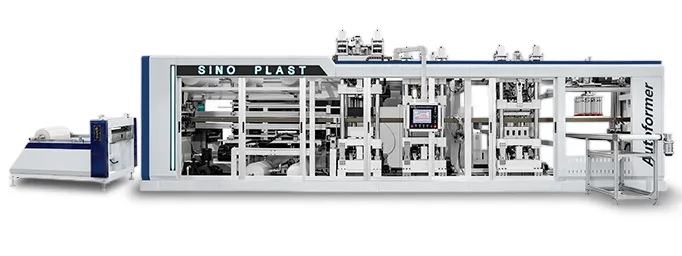
Thermoforming machines are primarily classified by their station sequence. Each station performs a distinct operation, and the number of stations determines what products the line can produce efficiently.
Basic station functions:
| Station | Operation | Required For |
|---|---|---|
| Forming | Heats sheet and shapes it using positive/negative pressure | All products |
| Punching | Creates holes, slots, or hinge cuts | Fruit boxes, cup lids, vented trays |
| Cutting | Separates formed parts from sheet web | All products |
| Stacking | Collects finished parts | All products (some machines combine cutting and stacking) |
The two most common configurations in food packaging are three-station (forming → cutting → stacking) and four-station (forming → punching → cutting → stacking). Some specialized machines integrate cutting within the forming station — often called in-mold cutting — which reduces the need for a separate cutting station.
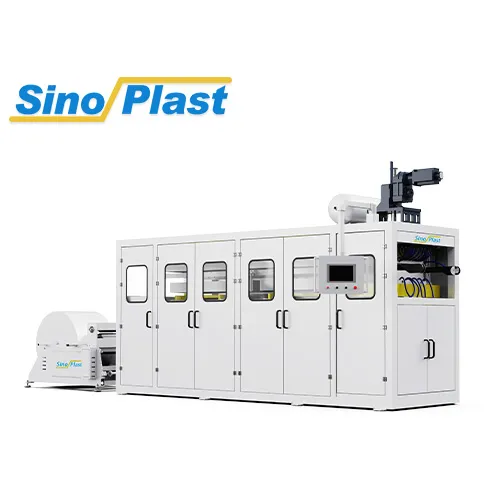
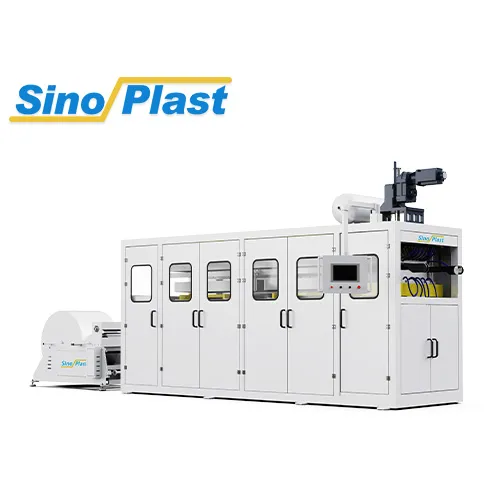
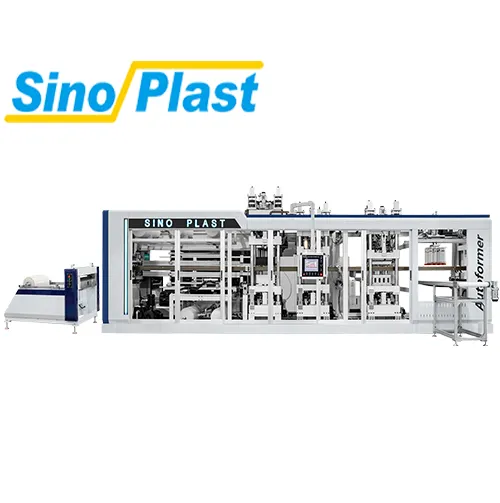
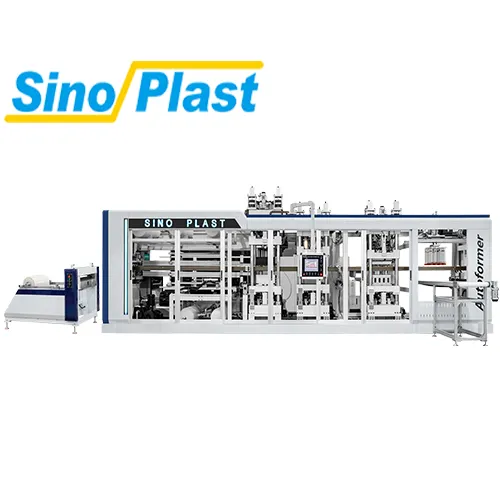
To see how station counts are implemented in actual thermoforming equipment, review the plastic thermoforming machine configurations overview.
The choice between three and four stations comes down to one question: Does your product need punching?
| Comparison Factor | Three-Station Machine | Four-Station Machine |
|---|---|---|
| Station sequence | Forming → Cutting → Stacking | Forming → Punching → Cutting → Stacking |
| Handles ventilation holes? | No holes require separate offline punching | Yes — integrated punching creates holes in line |
| Handles hinge cuts (lids)? | No — hinge perforations not possible | Yes — scoring or partial cuts integrated |
| Best for these products | Solid cups, basic trays, bowls, plates | Fruit boxes, cup lids, vented containers, products with holes |
| Secondary equipment needed | Separate punching press or manual operation | None — finished parts exit directly |
| Labor for extra handling | Yes — parts must be moved and realigned | No — fully continuous |
The practical trade-off: A three-station machine has a lower initial equipment cost. However, if your product requires punching, you will need to purchase a separate punching press and assign labor to transfer parts between machines. Alignment becomes a challenge — holes may drift relative to formed features. For high-volume production, the extra handling cost often exceeds the upfront savings.
A four-station machine costs more initially but eliminates the secondary operation. Parts move from forming directly into punching, with servo-driven alignment maintaining hole position accuracy across millions of cycles.
According to industry equipment technical literature, a fully integrated four-station system includes forming, punching, cutting, and stacking functions, allowing finished products to exit the line directly without secondary handling.
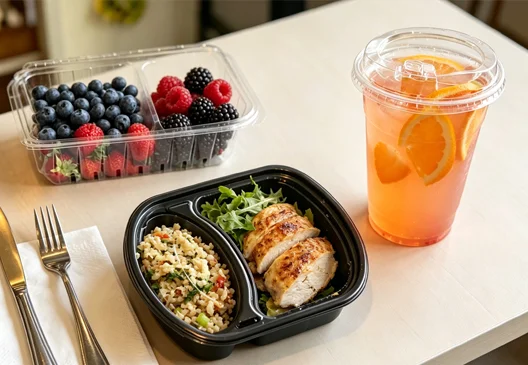
Use this step-by-step framework to evaluate which configuration fits your production plan.
Include current products and potential future items. If any product requires holes, slots, or hinge cuts, the four-station becomes the appropriate choice for integrated production.
Fruit tray: ventilation holes (size, pattern, quantity)
Cup lid: drinking hole, hinge score, tear-off perforation
Food container: drainage slots, steam vents
No holes: three stations may suffice
Low volume (a few hundred thousand parts/month): offline punching may be tolerable
High volume (millions of parts/month): inline punching reduces labor and alignment rejects significantly
If you run many different hole patterns (different fruit sizes, various lid designs), verify that the punching station supports quick tooling changes. Four-station machines with modular punch dies allow faster changeover than separate punching presses.
A four-station line occupies roughly the same floor space as a three-station machine plus a separate punch press — but without the extra material handling area between them. For tight layouts, integrated punching saves space.
Thermoforming machines used for cups and lids have additional variations beyond station count.
Cup-making machines often combine forming and cutting in the same station (in-mold cutting). The sheet is formed, then cut while still in the mold. This design eliminates a separate cutting station and works well for round or oval cups without complex hole patterns. These machines typically use a forming area layout (e.g., 760 x 320mm, 760 x 450mm, or 760 x 540mm), where larger areas accommodate more cavities per cycle.
Lid-making machines for hinged or perforated lids require punching capability. A four-station configuration with programmable punching depth allows:
Full punch-through for drinking holes
Partial scoring for living hinges
Perforation lines for tear-off tabs
If you produce both solid cups and punched lids, consider whether your line can handle both. Some manufacturers use a three-station cup machine for cups and a separate four-station line for lids. Others invest in a four-station machine that can run cups (with punching station idle or bypassed) and lids (with punching active).
Different product categories — cups, lids, trays, fruit boxes — have distinct thermoforming requirements. For an overview of which products match which machine types, explore the Sinoplast plastic thermoforming machine to match machine configurations to your production applications.
A manufacturer produces 2 million PS cups per month. Cups are solid — no holes, no hinges. Current line uses a three-station machine with in-mold cutting.
Key considerations: No punching needed. A three-station configuration is appropriate. The priority is cycle speed (35-40 cycles per minute) and forming area size to maximize cavities per cycle. Larger forming layouts (e.g., 760 x 540mm) allow more cups per cycle, increasing output without speeding up the machine.
A packaging converter produces ventilated berry trays (six-hole patterns) and hinged lids for cold cups. Monthly volume: 800,000 trays + 500,000 lids.
Key considerations: Punching required for both product lines. A four-station machine with servo-driven punching and quick-change tooling is appropriate. The manufacturer can change punch dies between berry tray holes (small round pattern) and lid hinges (scored line) in under 30 minutes, keeping changeover downtime manageable.
A new food packaging business plans to offer cups, lids, and small fruit trays. Initial volumes are low (50,000-100,000 parts/month per product).
Key considerations: Investing in separate lines for each product type is capital-intensive. A four-station machine with punching capability can run all three: cups (punching idle), lids (punching active for holes/hinges), and fruit trays (punching active for vents). The flexibility allows the startup to serve multiple market segments with one machine, deferring specialized equipment until volumes justify it.
While station count is the primary classification, other features affect real-world performance.
Drive type: Servo motors on feeding, stretching, and mold movement provide more precise control than pneumatic or cam-driven systems. For products with deep draws or tight tolerance requirements, servo control reduces stretch marks and improves wall uniformity.
Frame construction: Four-guide column or square steel frame designs maintain alignment under high cycling loads. This is particularly important for punching stations, where misalignment causes off-center holes or premature tool wear.
Heating system: Energy consumption matters. Some machines offer German-brand heating elements (e.g., ELSTEIN) that reduce electricity costs over time. For operations in high-electricity-cost regions, this upgrade can pay for itself within months.
Quick mold change: Machines with one-button mold locking and parameter storage reduce changeover time from hours to minutes. If you run multiple product shapes, verify how the machine handles mold swaps.
You now have a decision framework based on your actual product requirements:
No holes, no hinges → Three-station (or in-mold cutting cup machine) is likely sufficient
Holes or hinges required → Four-station with integrated punching is the appropriate configuration
Mixed production (cups + lids) → Consider a four-station machine that can bypass punching when not needed
The key decision factors are not about specific model numbers but about matching station count and punching capability to your product portfolio and volume.
Once you have clarified whether your production requires punching — and how often you will change between hole patterns — comparing the specific specifications of available thermoforming machines becomes the logical next step. You can review how different station configurations, drive systems, and forming areas address various production scales.
Three-Station vs Four-Station Thermoforming: Total Cost of Ownership
In-Mold Cutting vs Separate Cutting Station: Which Reduces Waste?
Servo-Driven vs Pneumatic Thermoforming Machines: Precision and Speed
Quick-Change Mold Systems: Calculating Downtime Savings
Thermoforming Line Layout: From Sheet Extrusion to Stacking
We are a professional plastic machinery provider in China.