
 Jun 09,2026
You want to produce fruit trays with ventilation holes or cup lids with drinking openings. The thermoforming process seems straightforward — heat sheet, form shape, cut, stack. But when you actually run the line, you discover that standard forming without punching leaves holes unpunched, requiring a separate operation. Production slows, handling increases, and consistency suffers.
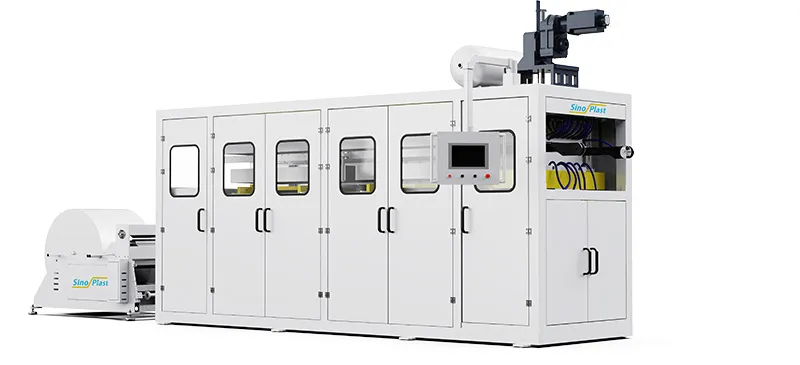
This guide explains the specific equipment considerations for thermoforming products that require punching — fruit boxes (ventilation holes, drainage slots) and cup lids (drinking openings, hinge tabs, tear-off corners). You will learn why station count matters, how punching affects line design, and what to ask when evaluating equipment.
Not all thermoformed products need punching. A basic cup or a solid tray forms, cuts, and stacks without any hole-making step. But fruit boxes and cup lids are different.
Ventilation holes to allow airflow and moisture escape
Drainage slots at the bottom for washing applications
Often produced from PS or PET sheet
Drinking hole (with or without a tab)
Hinge design that allows the lid to stay attached after opening
Tear-off corner for easy peel
These features cannot be created by the forming station alone. Forming creates the shape — the cavity, the rim, the lid‘s curved profile. Punching creates holes and cuts. If your product needs both forming and punching, the equipment must handle both operations in a continuous flow.
According to industry equipment technical literature (2025), fruit packaging and cup lids typically require punching, which is why four-station thermoforming machines with an integrated punching station are commonly used to complete punching immediately after forming, avoiding separate offline handling.
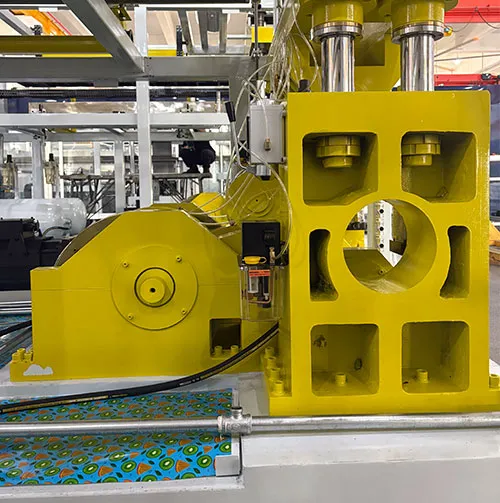
This is the central decision point for fruit box and cup lid production.
| Feature | Three-Station Thermoforming | Four-Station Thermoforming |
|---|---|---|
| Station sequence | Forming → Cutting → Stacking | Forming → Punching → Cutting → Stacking |
| Can produce fruit boxes with holes? | No holes would require separate post-forming punching | Yes — punching station creates holes in-line |
| Can produce hinged lids? | Limited — hinge cuts must be done offline | Yes — punching station can create hinge perforations |
| Extra handling required | Yes — parts must be moved to a separate press | No — all operations in one continuous line |
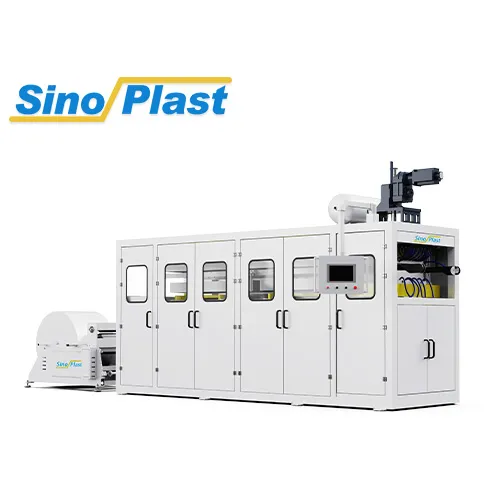
The practical implication: A three-station machine can form a beautiful fruit box shape. But the box will have no ventilation holes until you run it through a separate punching machine — adding labor, floor space, and alignment rejects. For cup lids, a three-station machine cannot create the hinge cut that allows the lid to stay attached to the cup rim.
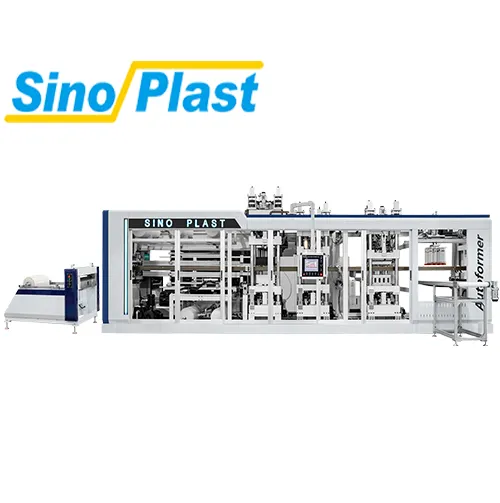
In a four-station thermoforming machine, the sheet passes through forming, punching, cutting, and stacking stations in sequence. A fully integrated four-station system includes forming, punching, cutting, and stacking functions. This allows finished products to exit the line directly without secondary handling.
To see how station configurations are arranged in actual equipment, review plastic thermoforming machine types by station count.
If your product needs punching, the quality of that station determines the consistency of holes and cuts.
| Feature | Why It Matters for Fruit Boxes & Lids |
|---|---|
| Servo motor-driven punching | Precise timing alignment with forming station reduces missed holes or misaligned cuts |
| Quick-change punch tooling | Fruit box hole patterns vary by fruit type (berries vs. larger fruits need different hole sizes); faster changeovers mean less downtime |
| Rigid frame construction | Four-guide column or sturdy steel frame reduces vibration during punching, maintaining hole accuracy |
Use this five-step checklist when assessing equipment for fruit box or cup lid production.
Fruit box: Are ventilation holes required? What size and pattern?
Cup lid: Is a drinking hole needed? Hinge? Tear-off corner?
If yes to any, a four-station is typically required for integrated production.
Simple round holes: standard punch tooling works
Slots, ovals, or custom shapes: verify that the punching station accepts custom die sets
Hinge perforations along a curve: requires precision alignment between forming and punching stations
Ask how the punching station aligns with formed parts. Equipment with servo-driven synchronization between forming and punching stations maintains better alignment over long production runs compared to purely mechanical linkages that may drift.
Switching from a fruit box (ventilation holes in bottom) to a cup lid (drinking hole in center) requires different punch tooling. Verify how long changeovers take and whether tooling can be swapped efficiently.
Different materials respond to punching differently. PS punches cleanly but can crack if too brittle. PP tends to stretch; punch designs may need adjustment. PET punches well but requires sharper dies. Understand how your chosen material behaves under punching conditions.

A manufacturer wants to produce clear PET fruit boxes for raspberries or blueberries. Requirements include multiple ventilation holes in the bottom for airflow and drainage slots at corners.
Critical considerations: The punching station must handle small-diameter holes without tearing the sheet. PET sheet used for such applications typically falls in the 0.3-0.5mm range for lightweight berry packaging. A four-station machine with properly designed punch tooling produces clean holes without secondary deburring.
A producer of cold drink cups wants to produce lids with a drinking hole and a hinged tab.
Critical considerations: The hinge requires a partial cut — not a full punch-through. For polypropylene (PP) living hinges, the hinge region must be significantly thinner than the adjacent walls; a thickness between 0.25mm and 0.5mm is typically considered suitable. The punching station must have an adjustable stroke depth to score without cutting entirely. The hinge‘s alignment with the lid’s profile demands high registration accuracy between forming and punching stations.
Every type of food packaging has unique thermoforming processing demands. Browse our complete guide to find suitable machine configurations for your target products, and explore our lineup of plastic thermoforming machines.
Cup lids deserve separate attention because they combine three challenging features in one small part: complex curvature (to snap onto a cup rim), drinking hole, and often a hinge.
Material choice impact:
PS lids are common for cold drinks (clear, rigid)
PP lids are used for hot drinks (heat-resistant but less clear)
PET lids appear in premium packaging
Punching station requirement for lids: The punching station must handle drinking holes (full punch-through), hinge scoring (partial cut), and tear-off tab perforations (series of small punches along a line). A four-station machine with programmable punching depth can perform multiple operations in sequence. Three-station machines cannot — leaving you to perform hinge scoring offline, which rarely aligns perfectly.
You now have a framework for fruit box and cup lid production: if your product requires holes, slots, or hinge cuts, a four-station thermoforming line with an integrated punching station is the appropriate configuration to investigate.
The key decision factors are not about specific model numbers but about:
Station count (three vs four — punching requirement typically decides this)
Punching station features (servo control, quick-change tooling)
Registration accuracy between forming and punching
Once you have confirmed your product‘s punching requirements — hole pattern, hinge design, material — comparing specific equipment specifications becomes the logical next step.
Three-Station vs Four-Station Thermoforming: Which Reduces Downstream Handling?
Hinge Design for Thermoformed Lids: Scoring Depth and Material Selection
Ventilation Hole Patterns for Fruit Packaging: Airflow vs Structural Strength
PET vs PS for Punched Products: Formability and Punch Cleanliness
Quick-Change Punch Tooling Systems: Reducing Changeover Time
We are a professional plastic machinery provider in China.