
 Jul 10,2026
You are planning to produce disposable plastic cups, bowls, or plates. You have researched suppliers, compared prices, and narrowed down your options. But when it comes to actually selecting a thermoforming machine, the technical specifications can be overwhelming — forming area, servo motors, heating elements, and material compatibility. Getting any of these wrong means either paying for features you do not need or discovering after installation that the machine cannot handle your products.
This guide offers five practical tips to help you evaluate plastic cup thermoforming machines. Each tip focuses on a specific decision point — from forming area to after-sales support — so you can match equipment to your actual production requirements.
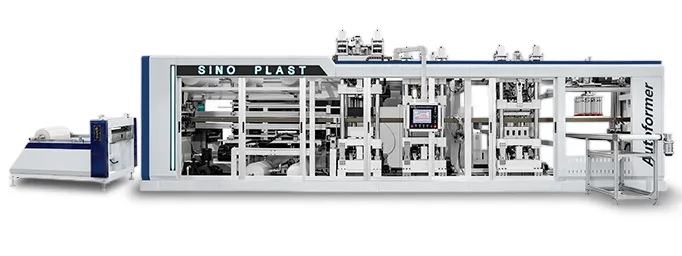
The forming area — the maximum dimensions of the sheet that can be formed in each cycle — directly determines how many cavities (products) you can produce per cycle and what size products you can make.
Key specification: Plastic cup thermoforming machines typically offer multiple forming area options. Common layouts include 760 x 320mm, 760 x 450mm, and 760 x 540mm. The larger the forming area, the more cavities the mold can accommodate.
Why it matters for your production:
| Forming Area | Best For | Practical Implication |
|---|---|---|
| 760 x 320mm | Smaller cups, lower volume, limited floor space | Fewer cavities per cycle; lower output; lower initial cost |
| 760 x 450mm | Medium cups, balanced output | Moderate cavities; good for most standard applications |
| 760 x 540mm | High-volume production, larger products | More cavities per cycle; higher output; higher initial cost |
How to choose: Calculate your required monthly output, then work backward. If you need 1 million cups per month, a smaller forming area may require running more shifts or longer hours. A larger forming area allows more cavities per cycle — potentially reducing operating hours and labor costs. However, the machine itself costs more upfront.
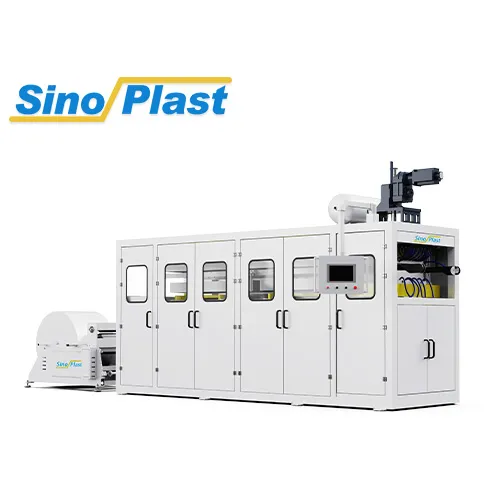
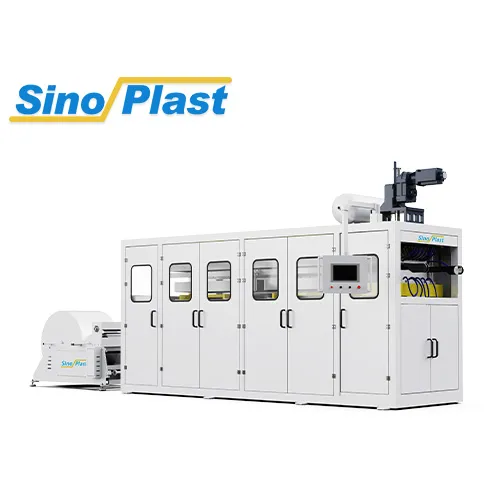
To see how different forming area options are implemented in actual cup making equipment, review the plastic cup machine configurations overview.
Plastic cup thermoforming machines use servo motors to control various movements — feeding the sheet, stretching the material, and moving the lower mold. The number and placement of servo motors affect precision, adjustability, and maintenance requirements.
Common configurations:
| Configuration | Servo Locations | Best For |
|---|---|---|
| Three-servo | Feeding, stretching, and lower mold movement | High precision; reduced stretch marks; easier adjustment |
| Single-servo | Lower mold stage only | Stretching driven by a cylinder; feeding driven by regular motor |
What this means for your production:
Three-servo machines offer more precise control over each movement. The servo motor on the stretching station, for example, reduces stretching patterns on the product and significantly reduces noise during production. This matters for products with deep draws or complex shapes where stretch marks would affect appearance.
Single-servo machines have lower initial cost but may produce more stretch marks and operate with less precision. If your products have simple geometries and appearance is not critical, a single-servo machine may be sufficient.
Practical advice: If you are producing cups with printed branding or clear PET cups where optical quality matters, the three-servo configuration is worth the additional investment.
The heating system is one of the largest ongoing operating costs for a plastic cup thermoforming machine. The choice of heating elements affects both energy consumption and production quality.
Two common options:
| Heating Element Type | Typical Source | Best For |
|---|---|---|
| Standard heating elements | China-produced | Lower upfront cost; acceptable performance |
| Premium heating elements | German ELSTEIN brand | Higher efficiency; lower energy consumption over time |
Why this matters: For customers in countries with high electricity prices, ELSTEIN heating elements can significantly save electricity costs during the production process. The premium elements cost more upfront but pay for themselves through reduced energy bills over the machine's lifespan.
How to decide: Calculate your estimated annual electricity consumption for the heating system, then compare the energy cost difference between standard and premium elements. Multiply by the expected machine lifespan (typically 5-10 years). If the cumulative energy savings exceed the upfront cost difference, premium elements are the better financial choice.
Plastic cup thermoforming machines support different materials — PP, PS, and PET are the most common. Each material behaves differently during forming, affecting both speed and quality.
Material-specific considerations:
| Material | Typical Applications | Processing Speed | Special Requirements |
|---|---|---|---|
| PS | Cold drink cups, clear packaging | Faster | Easy to form; good clarity |
| PP | Hot drinks, dairy cups, microwaveable | Slower | Higher heating temperature required |
| PET | Cold beverages, premium packaging | Faster | Requires pre-drying; moisture-sensitive |
Speed implications: A thermoforming machine can reach speeds of up to 40 molds per minute with PET and 30 molds per minute with PP, depending on product depth and sheet thickness. Deeper products require longer molding time — running too fast may cause incomplete molding.
Practical tip: If you plan to run multiple materials, verify that the machine supports quick changeover between material settings. Machines with PLC control and touch screens can store parameters for different materials, enabling quick setup by simply pressing start.
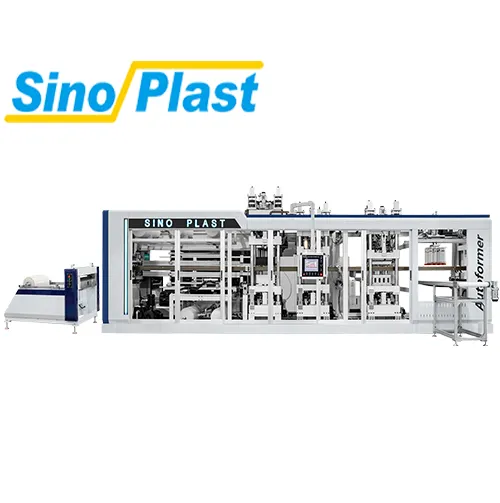
Different food packaging categories come with unique thermoforming specifications. For a full overview of product-matched machine setups, explore plastic cup thermoforming machines.
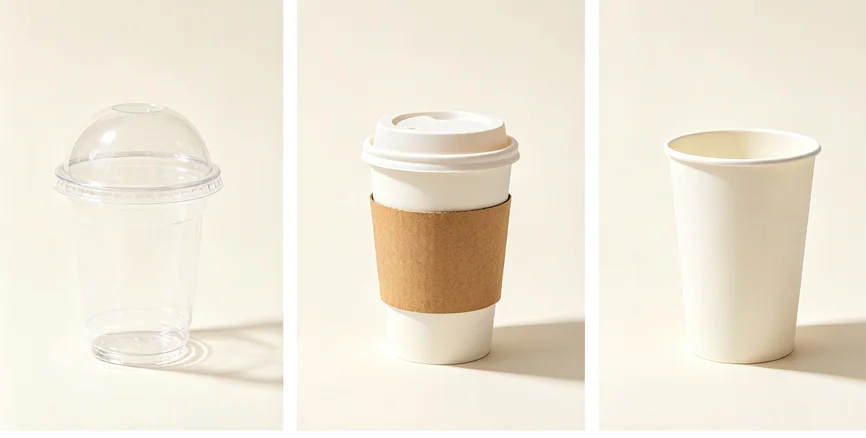
The purchase price is only one part of the total cost. Installation, training, maintenance, and ongoing support add to the overall investment.
Space requirements: A plastic cup making machine for production requires a minimum area of 200 square meters. Verify your facility has sufficient space not only for the machine itself but also for material storage, finished product handling, and auxiliary equipment (chiller, air compressor, storage tank).
Installation and support: After the machine is transported to your factory, the manufacturer should send engineers to install and adjust it, and guide your operators in machine operation and maintenance. Verify what is included in the purchase price and what costs are additional (travel, accommodation, visa fees).
Warranty and after-sales: Check the warranty period and what it covers. For machines with PLC controls and multiple servo motors, verify that spare parts are available and that the manufacturer provides remote or on-site technical support.
Total cost of ownership checklist:
Initial purchase price
Installation and commissioning costs
Operator training
Energy consumption (heating elements, motors)
Maintenance and spare parts
Downtime cost for repairs
Use this five-step framework to evaluate plastic cup thermoforming machines based on the tips above:
What size cups/ bowls/ plates will you produce? (determines forming area)
What material? PP, PS, or PET? (affects speed and heating requirements)
What is your target monthly output? (determines forming area and cavities)
Small/medium volume → 760 x 320mm or 760 x 450mm
High volume → 760 x 540mm
Basic requirements, simple shapes → single-servo
Precision requirements, deep draws, branded products → three-servo
Low electricity cost → standard heating elements
High electricity cost → premium ELSTEIN elements
Include installation, training, energy, and maintenance
Confirm minimum space requirement (200 sqm)
Review warranty and after-sales support
You now have a practical framework for picking a plastic cup thermoforming machine based on your actual production needs. The five tips — forming area, servo configuration, heating elements, material compatibility, and total cost of ownership — provide a structured way to evaluate options without getting lost in technical details.
The key is to start with your products and output targets, then work backward to identify the machine specifications that match. Once you have confirmed these requirements, comparing specific equipment specifications becomes the logical next step.
How Forming Area Affects Cup Production Output
Understanding Servo Motors in Thermoforming: Precision vs Cost
PET vs PS vs PP: Material Selection for Cup Production
Thermoforming Line Layout: Space Planning for 200 sqm and Beyond
We are a professional plastic machinery provider in China.