
 Jul 15,2026
You are planning to produce plastic cups, bowls, or food containers. The machine specifications are clear — forming area, servo motors, and heating elements. But one decision remains: which material will you run? PET offers crystal clarity but requires drying. PP handles hot fills but runs slower. PS is cost-effective but faces regulatory headwinds.
The choice between PET, PS, and PP is not about which material is “better” — each has established roles in the industry. The right choice depends on your end products, target markets, and production priorities.
This guide compares the three materials across clarity, heat resistance, processing speed, cost efficiency, and sustainability to help you make an informed decision.
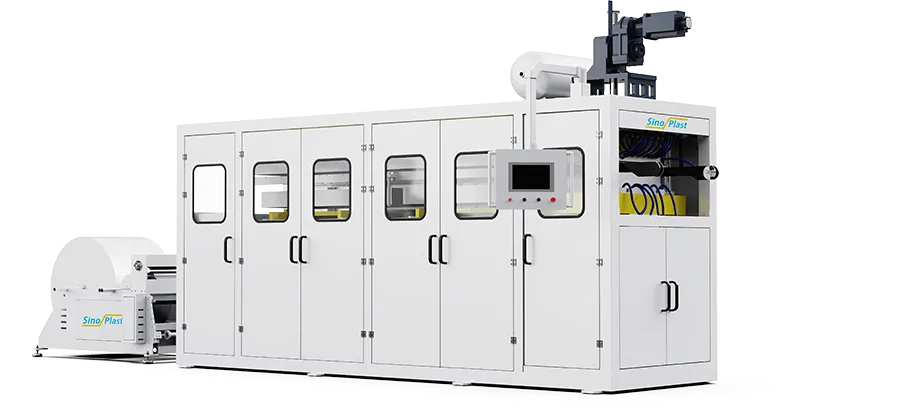
PET (Polyethylene Terephthalate), PS (Polystyrene), and PP (Polypropylene) are the three most common materials used in disposable cups and food container thermoforming. Each has distinct characteristics that affect both the manufacturing process and the final product.
| Property | PET | PS | PP |
|---|---|---|---|
| Density (g/cm³) | 1.38–1.41 | 1.04–1.09 | 0.89–0.91 |
| Transparency | Excellent (up to 90% light transmission) | Good (clear grades available) | Milky/cloudy (clarified grades available) |
| Heat resistance | ~70°C (softens above) | ~80°C | ~120°C |
| Moisture sensitivity | High — requires pre-drying | Low | Low |
| Impact resistance | High | Moderate — can be brittle | Good |
| Chemical resistance | Good | Moderate | High |
| Recyclability | Highly recyclable (resin code #1) | Limited | Recyclable |
What this means for you: PP has the lowest density among common polymers — offering up to 30% density reduction from PET. This means more cups per kilogram of raw material, directly affecting material cost per unit. PET delivers premium clarity for branding and product visibility. PS sits in the middle — affordable and easy to form, but increasingly challenged by sustainability regulations.
The same thermoforming machine will run PET, PS, and PP at different speeds and with different settings. Understanding these differences helps you avoid production surprises.
Heating requirements: The PET sheet requires lower heating temperatures than PP, enabling faster cycle speeds. The machine can reach speeds of up to 40 molds per minute with PET and 30 molds per minute with PP. PS falls between the two — faster than PP but generally slower than PET. PP has a higher specific heat and a narrower forming window, which often results in slower cycle speeds to ensure the part reaches a “freeze” temperature where it can be ejected without deforming.
Moisture sensitivity: PET is hygroscopic — it absorbs moisture from the environment. Proper pre-drying is essential; otherwise, surface defects such as smearing may occur. PS and PP do not require pre-drying, simplifying their processing workflow.
Forming temperature range: PS forms at lower temperatures (typically 160–200°C), PET at moderate temperatures, and PP requires the highest forming temperatures due to its semi-crystalline structure.
To see how different forming area options and servo configurations support various materials, review the plastic cup making machine configurations overview.
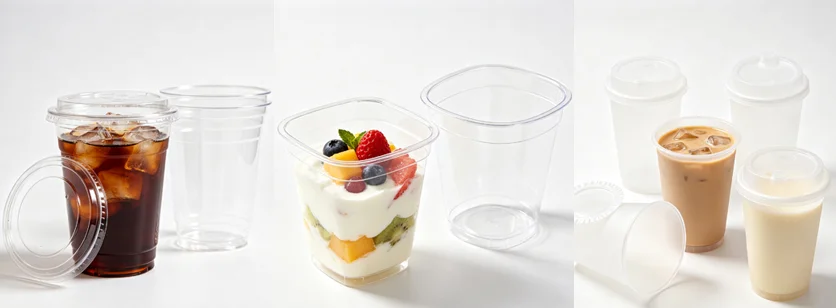
The best material depends on what you are producing and where those products will be used.
Cold beverage cups. PET‘s crystal clarity makes it the preferred choice for cold drinks — bottled water cups, iced coffee, smoothies, and juice cups where product visibility matters. PET offers exceptional clarity and strength, making it ideal for applications where the product inside needs to be visible.
Premium retail packaging. The high impact resistance and glass-like transparency convey quality for retail applications.
Fruit and produce containers. PET is the dominant choice for fresh produce display due to its balance of safety, clarity, strength, and environmental sustainability.
Recycling-focused markets. PET is highly recyclable and faces fewer regulatory restrictions than PS.
Basic disposable cups and containers. PS is one of the most cost-effective materials used in thermoforming, commonly used in disposable packaging and food containers.
Low-cost, high-volume applications. PS is lightweight and easy to mold, making it an economical choice for mass production where premium appearance is not required.
Products without heat exposure. PS performs well in cold food applications and display purposes.
Hot beverage cups and microwaveable containers. PP can withstand higher temperatures than PET and PS, making it suitable for applications involving heat, such as microwaveable food containers and hot drink cups.
Dairy cups. Yogurt cups, pudding cups, and ice cream containers are frequently made from PP due to its durability and lightweight nature.
Living hinge lids. If your product line includes lids that need to open and close repeatedly without breaking, PP‘s hinge performance is superior to PET.
Lightweight packaging priorities. PP has the lowest density among the three materials, delivering more containers per kilogram of raw material.
For a complete breakdown of machine configurations tailored to different plastic packaging products, browse our full range of plastic cup making machines.
Material cost per kilogram is only part of the equation. Yield — how many parts you get from a given weight of material — is equally important.
Density and yield relationship: Because PP has the lowest density (0.89–0.91 g/cm³) compared to PS (1.04–1.09 g/cm³) and PET (1.38–1.41 g/cm³), lower-density materials result in more linear feet per pound of rollstock. Holding gauge and width constant, PP generates significantly more parts per kilogram than PET.
Practical example: For the same weight of material, PP yields approximately 30% more parts than PET. This yield advantage can offset PP‘s potentially higher processing costs or slower cycle speeds.
Energy costs: PET requires energy-intensive drying, which adds to operating costs. PP has a lower density and can offer cost advantages in material consumption, but may require higher forming temperatures and longer cycle times.
Environmental regulations increasingly influence material selection, particularly for producers exporting to the European market.
EU Packaging and Packaging Waste Regulation (PPWR): From 2030, every plastic component of packaging must contain a minimum percentage of certified post-consumer recyclate (PCR). Key targets include:
PET packaging in direct contact with food and drink: 30% recycled content by 2030, increasing to 50% by 2040
Other plastics (non-PET) in direct contact with food and drink: 10% recycled content by 2030, increasing to 25% by 2040
All other plastic packaging: 35% by 2030, increasing to 65% by 2040
What this means for your material choice: PET has an established recycled content supply chain and higher mandated targets. If your target market includes the EU, PET may be more attractive for compliance reasons, provided you can source adequate recycled-content sheet. For PP, the recycled content requirement is lower — 10% starting in 2030 — but the recycled supply chain for food-contact PP is less mature.
Recycling infrastructure: PET is one of the most recyclable plastics, making it a more environmentally friendly choice compared to other materials. PS faces environmental challenges due to recycling limitations. PP is recyclable but has lower collection and recycling rates than PET in many regions.
Producer obligations: Any producer offering packaging or packaged products on the European market is covered by these regulations, even if the company itself is located outside the EU.
Use this step-by-step framework to evaluate which material fits your production needs.
Will the filled cup encounter heat (hot drinks, microwave)? → PP required
Is crystal clarity critical for branding or product visibility? → PET preferred
Is this a basic disposable application with no heat or clarity demands? → PS may suffice
EU market with recycled content mandates? → PET has clearer regulatory path
Markets without strict mandates? → All three materials viable
Maximizing cycle speed? → PET runs fastest
Minimizing material cost per part? → PP offers highest yield per kilogram
Simplicity of processing (no drying, easy forming)? → PS or PP
Will you produce multiple product types? → Verify your machine supports multiple materials
Quick changeover features (recipe storage) reduce downtime between material switches
A manufacturer supplies clear PET cups for a national bubble tea chain. Transparency is essential for branding. The product is served cold. The target market has EU export ambitions.
Material fit: PET is the appropriate choice. The crystal clarity meets branding requirements. The higher recycled content targets (30% by 2030) align with EU regulatory compliance. The machine can run PET at faster cycle speeds, maximizing output.
Machine considerations: PET‘s lower heating requirement means faster cycles, but the machine must have precise temperature control. Pre-drying equipment is required for PET sheet storage.
A manufacturer produces 200ml yogurt cups for a dairy customer and coffee cups for a national café chain. Both require heat resistance — yogurt cups for filling lines, coffee cups for hot beverages.
Material fit: PP is the appropriate choice. It withstands temperatures up to 120°C. The lower density means more cups per kilogram of material, offsetting the slightly slower cycle speed.
Machine considerations: PP requires higher forming temperatures and a narrower processing window. The machine must have robust temperature control and recipe storage for consistent results.
A converter produces cups for both cold juice and hot coffee, plus fruit trays, for multiple brands. Monthly volume is split 40% cold (PET), 40% hot (PP), 20% fruit trays (PET).
Material fit: Neither single material covers all applications. The converter needs either two production lines — one optimized for PET, one for PP — or a single machine with recipe storage that can switch between materials.
Machine considerations: A thermoforming machine that supports both PET and PP is available, but changeovers require adjusting heating profiles and temperatures. Faster changeover features — such as parameter storage for different materials — reduce downtime between production runs.
You now have a framework for choosing between PET, PS, and PP based on your product requirements, target applications, and regulatory environment:
PET for cold drinks, clarity-critical applications, and markets with high recycled content mandates
PS for cost-sensitive basic disposable applications where clarity and heat resistance are not priorities
PP for hot drinks, dairy cups, living hinge lids, and lightweighting priorities
The material decision is not about which plastic is “better” — each has established roles in the industry. The right choice depends on your specific product profile.
Once you have determined which material or materials suit your product line and target markets, comparing specific machine specifications for your chosen material becomes the logical next step. You can review how different forming areas, servo configurations, and heating systems address various production scales and material requirements.
PET Sheet Pre-Drying Requirements: Why Moisture Control Matters
Optimizing Thermoforming Cycles for PET vs PS vs PP
Recycled Content in Thermoforming: Sourcing PCR Sheet and Adjusting Machine Parameters
Forming Area and Cavity Count: Calculating Output for Different Cup Sizes
Material Yield Comparison: How Density Affects Cost Per Container
We are a professional plastic machinery provider in China.