
 Jun 01,2026
You have decided to produce disposable plastic packaging — cups, containers, trays, or lids. The logical next step is assembling the right equipment. But here is where many producers stumble: they evaluate thermoforming machines and sheet extruders separately, missing how these components must work together. The result? A sheet that does not feed smoothly, formed parts with uneven walls, or a line that stops too often for adjustments.
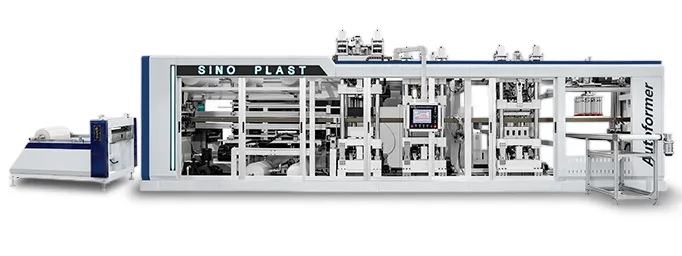
This guide walks through the key compatibility decisions when planning a thermoforming production line — from sheet extrusion through forming, cutting, and stacking — using the actual equipment categories available from manufacturers like Sinoplast, without diving into specific model pricing or promotional claims.
A complete plastic packaging line connects four main stages. Each stage affects the next, and mismatches anywhere along the chain increase scrap and reduce output.
The production sequence:
| Stage | Equipment Type | Primary Function |
|---|---|---|
| 1 | Sheet extruder | Produces PP/PS/PET sheet from raw material or regrind |
| 2 | Thermoforming machine | Heats sheet and forms into shape (positive/negative pressure) |
| 3 | Cutting/punching station | Separates formed parts from remaining sheet web |
| 4 | Stacking unit | Collects finished products for packing |
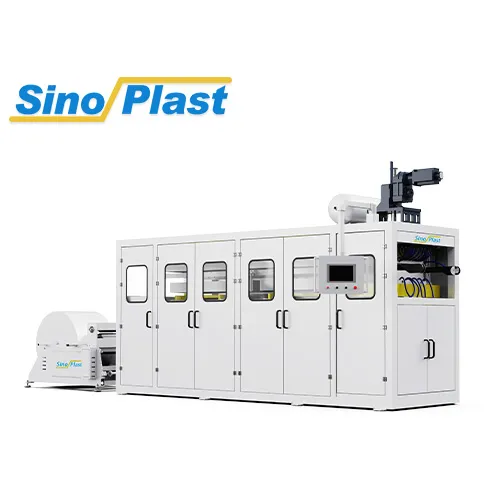
Some machines combine stages — for example, a four-station thermoforming machine integrates forming, punching, cutting, and stacking in one line. Others use separate units. The right configuration depends on your product type, required output, and available floor space (typically a minimum of 200 square meters for a complete cup making line, according to industry practice).
According to processing guidelines from the Plastics Industry Association, integrating cutting within the forming station (in-mold cutting) reduces edge trim waste by approximately 12-18% compared to post-form trimming — a meaningful saving for high-volume cup and lid production.
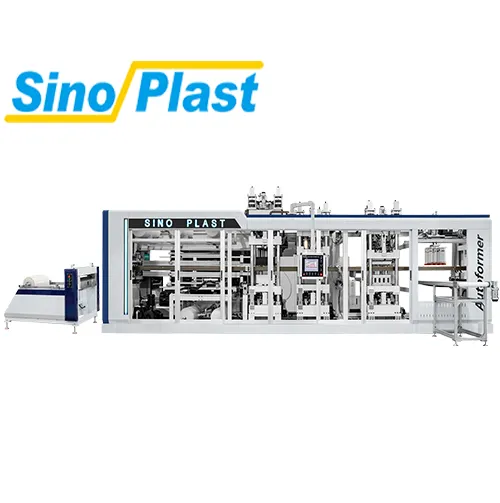
For manufacturers producing both containers and lids, understanding how station configurations differ becomes essential. You can review multi-station thermoforming machine configurations to see the difference between three-station and four-station layouts.
The sheet is the raw material your thermoforming machine will actually process. Extrusion equipment must produce a sheet with three specific characteristics that directly affect forming success.
Technical term: Gauge variation across sheet width
What it means for you: When sheet thickness varies, thin areas overheat and tear during stretching; thick areas underheat and produce incomplete fills.
What to look for: An extruder with independent temperature control zones along the barrel and die. More zones allow finer adjustment. For packaging sheets in the 0.25-2.0mm range, automatic gauge control with scanning sensors helps maintain consistency without constant operator attention.
Technical term: Consistent sheet width without edge waviness
What it means for you: Thermoforming machines use chain rails to grip sheet edges. If width varies, the chain rails lose grip or the sheet buckles — causing jams that stop production.
What to look for: The extrusion die and take-off roll stack must maintain width within ±3-5mm across a full roll. Ask whether the line includes edge trim waste handling, as trim is typically 15-40mm per side and must be reintroduced as regrind.
Different materials require different extrusion setups:
| Material | Extrusion Requirement | Thermoforming Implication |
|---|---|---|
| PP | Longer screw L/D ratio, higher melt temperature | Tough forming requires deeper draw capability |
| PS | Narrow temperature window, uniform cooling | Easy forming, but brittle after cooling |
| PET | Pre-drying is required before extrusion | Excellent clarity, slower cycle speed |
External reference: The British Plastics Federation (BPF) notes in its 2023 processing guide that PP sheet extrusion accounts for approximately 34% of European rigid food packaging volume, driven by its heat resistance for microwaveable containers and improved recyclability compared to PS.
Your sheet extruder should support the materials you actually use. If you plan to switch between PP and PS regularly, look for lines with recipe storage that adjusts temperatures and screw speeds automatically.
Thermoforming machines are not one-size-fits-all. The number of stations determines what products you can make efficiently.
These machines separate forming, cutting/punching, and stacking into distinct stations. They work well for:
Products that do not require in-line punching (basic trays, shallow containers)
Lower-to-mid volume production
Simpler maintenance access between stations
Limitation: If your product requires punching (e.g., cup lids with hinge cuts or fruit trays with ventilation holes), a three-station machine cannot perform that operation. You would need separate punching equipment downstream.
These add a dedicated punching station before cutting and stacking. The advantage: punching is integrated into the continuous flow, eliminating a separate handling step.
Better for:
Cup lids with opening tabs
Fruit trays with holes
Products requiring precise hole alignment
High-volume production where extra handling costs are unacceptable
Based on actual machine specifications from manufacturers serving this industry, here are features that reduce operating problems:
| Feature | Why It Matters |
|---|---|
| Servo motor-driven stations | More precise position control than pneumatic cylinders; quieter operation; adjustable speed without mechanical changes |
| Four-guide column structure | Stable mold alignment reduces flash and uneven wall distribution |
| In-mold cutting (cup machines) | Cuts and forms in same station; eliminates separate trim press; reduces floor space |
| Quick mold change system | Operator pushes mold onto table and locks with one button; no manual alignment of upper and lower molds |
For manufacturers producing both standard cups and specialty lids, understanding how punching requirements affect machine selection is critical. You can review plastic thermoforming machine configurations by station count to compare three-station vs. four-station layouts.
Sheet extruders and thermoforming machines get the attention. But auxiliary equipment often determines whether a line runs reliably or stops repeatedly.
| Equipment | Function | What Happens If Undersized |
|---|---|---|
| Air compressor | Provides positive/negative pressure for forming | Slow cycle times; incomplete forming on deep draws |
| Chiller (water cooler) | Removes heat from molds | Extended cooling time; slower production speed; part warping |
| Air storage tank | Buffers compressed air supply | Pressure drops during peak demand; inconsistent forming |
| Material handling (mixer + feeder) | Delivers consistent raw material to extruder | Manual loading introduces contamination; inconsistent melt |
Sizing consideration: For a thermoforming machine producing at 35-40 cycles per minute, the air compressor must supply sufficient volume continuously. Undersizing is a common mistake — manufacturers sometimes buy a compressor sized for average consumption rather than peak demand during simultaneous forming and cutting strokes.
Use this checklist when discussing equipment options with any supplier. The goal is not to compare every specification but to verify compatibility with your actual production needs.
Cup depth? (Deeper draws require longer cooling time)
Does it need punching? (holes, hinge cuts, vent slots)
Material: PP, PS, PET, or blends?
Pieces per minute needed
Number of cavities per mold (larger forming area = more cavities)
Available operating hours per day/week
Three stations: forming, cutting, stacking (no punching)
Four stations: forming, punching, cutting, stacking (includes punching)
Electrical: most machines are designed for 380V/50Hz three-phase (special designs available at higher cost)
Cooling water: chiller capacity matching mold heat load
Compressed air: sufficient volume for peak demand
How long between mold changes for different products?
Are parameters stored for recall? (Machines with PLC storage eliminate re-tuning)
Consider a line producing 8oz disposable cups from a PS sheet. The operation uses:
PP/PS sheet extruder (200-300 kg/hr output range)
Plastic cup making machine with in-mold cutting
Three-servo design (feeding, stretching, lower mold movement controlled separately)
What makes this line work together: The extruder’s screw design (110-120mm diameter, appropriate L/D ratio) plasticizes PS without degradation. The cup machine’s forming area (760 x 320mm or larger) matches the sheet width from extrusion. The chiller removes heat from the mold quickly enough for 35-40 cycles per minute.
Where problems occur: If the extruder’s cooling rolls are undersized for summer temperatures, the sheet exits too warm and stretches unevenly in the cup machine. If the air compressor lacks storage capacity, pressure drops during simultaneous forming and cutting strokes, producing incomplete fills.
Resolution approach: Match auxiliary capacity to peak demand, not average consumption. Verify that the chiller specification includes a safety margin (typically 20-30% above calculated heat load).
You now have a framework for planning a thermoforming line based on your actual product requirements: material type, need for punching, output targets, and auxiliary support.
The key decisions are not about specific model numbers but about configuration compatibility:
Three stations or four? (punching requirement decides this)
Servo-driven or pneumatic? (precision vs. initial cost trade-off)
Extruder output rating relative to thermoforming consumption (buffer needed)
Once you have clarified these configuration points for your specific products — cup depth, lid complexity, tray geometry — comparing the detailed specifications of available equipment becomes the logical next step.
How Many Stations Does Your Product Need? Three-Station vs. Four-Station Thermoforming
Material Selection Guide: PP, PS, or PET for Food Packaging
Quick Mold Change Systems: Reducing Downtime Between Production Runs
We are a professional plastic machinery provider in China.