
 May 19,2026
In early 2024, a mid‑size packaging converter in Vietnam purchased what looked like a perfect thermoforming line. Six months later, they had burned through three mold sets, scrapped over 12 tons of sheet, and still couldn’t run PP at acceptable cycle speeds. The machine wasn’t “bad” – it was simply the wrong match for their material portfolio and part geometry.
This story repeats itself every year. As we move into 2025, the thermoforming market is seeing new demands: faster changeovers for short runs, deeper draws for sustainable fiber‑based materials, and tighter thickness control for lightweighting. So how do you cut through the noise and choose a forming system that actually fits your production reality?
Whether you’re making thin‑gauge disposable cups or heavy‑duty industrial trays, the decision comes down to five core engineering parameters. Let’s walk through each one, then look at common traps and how to avoid them.
The oven is the heart of any thermoforming operation. Uneven heating causes webbing, thin corners, and slow cycles.
| Heating Type | Pros | Cons | Best For |
|---|---|---|---|
| Quartz tube | Low upfront cost, fast response | Short lifespan (≈2000h), uneven edge‑to‑center heating | Simple applications, low‑output shops |
| Ceramic | Even heat distribution, durable (5000h+) | Slower warm‑up, higher energy consumption | Medium‑gauge sheets, consistent production |
| Medium‑wave IR | Excellent zone control, up to 30% energy savings, long life | Higher initial investment | High‑speed thin‑gauge, multi‑zone control |
For 2025, zoned IR heating with closed‑loop temperature feedback has become the industry benchmark. It automatically compensates for ambient temperature changes and sheet sagging. If you plan to run recycled PET (rPET) or bio‑based PLA, IR systems provide the precise energy profile these materials demand.
Your choice here determines depth‑of‑draw, detail reproduction, and cycle time.
Vacuum forming – Simple and low‑cost, but limited to shallow draws (depth < 1:1 ratio). Suitable for thick‑gauge trays and pallets.
Pressure forming – Uses compressed air (up to 100 psi) to push sheet into mold details. Excellent for sharp corners and textured surfaces. Adds 20‑30% to equipment cost but eliminates secondary finishing.
Twin‑sheet forming – Fuses two heated sheets together, creating hollow double‑walled parts. Ideal for pallets, automotive ducts, and insulated containers. Requires a more complex press and alignment system.
Most modern production lines for rigid packaging combine vacuum and pressure assist – a flexible setup that handles both thin lids and deep containers.
Trimming can become a bottleneck if mismatched with your output speed.
| Trimming Type | Cycle Time | Tooling Cost | Scrap Rate | Best Application |
|---|---|---|---|---|
| Steel rule die | 2‑5 sec | Low | Medium (frayed edges) | Small volumes, simple shapes |
| Matched metal (press trim) | 1‑2 sec | High | Very low | High‑volume, tight tolerances |
| In‑line laser | 0.5‑1 sec | None (digital) | Zero (vaporizes edge) | Short runs, complex contours |
For 2025, laser trimming is becoming affordable even for mid‑range lines, especially for medical and food packaging, where edge contamination is a concern. However, matched metal trimming remains the gold standard for high‑speed cup and lid production.
Many buyers focus only on today’s main material – usually PS or PET – and ignore future needs. Then they struggle when a customer asks for PP, PLA, or foam sheet.
Key material‑related specs to verify:
Maximum sheet width and thickness – PP and PLA require narrower temperature windows than PS.
Plug assist material – Wood, Teflon, or aluminum? For deep draws with PP, a heated aluminum plug with a specific surface texture reduces drag marks.
Cooling system – Semi‑crystalline resins (PP, PET) need longer cooling than amorphous PS. Ensure the line has independent top/bottom cooling air and optional water‑cooled molds.
Ask any supplier: “Can your system run 100% post‑consumer PP sheet at 4 mm thickness with a draw ratio of 1.5:1?” If they hesitate, keep looking.
Labor costs are rising globally. A line that takes six hours to change from a 500‑ml cup mold to a 1‑liter tray mold will kill your profit on short‑run orders.
In 2025, look for:
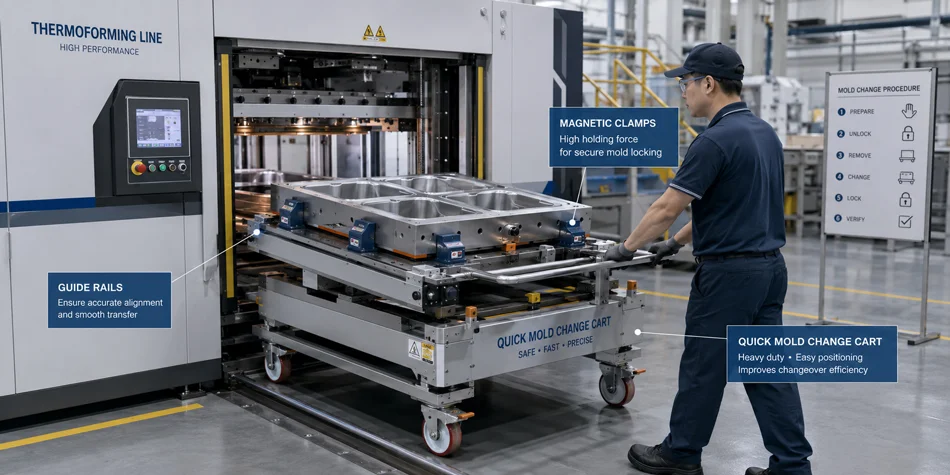
Quick‑mold‑change (QMC) systems with magnetic clamping or hydraulic cartridge locks (under 15 minutes changeover).
Recipe storage for heating zones, forming pressure, and trim timing – at least 50 recipes.
Optional stacker/bagging integration to reduce manual handling.
Some advanced forming and trimming systems now include servo‑driven chain rails that automatically adjust width based on the selected recipe, reducing changeover time from hours to minutes.
| Your Production Profile | Recommended Configuration | Estimated Investment |
|---|---|---|
| Low volume, wide variety (job shop) | Quartz heating + vacuum forming + steel rule trim | $ |
| High volume, thin‑gauge cups (food service) | IR zoning + pressure forming + matched metal trim | $$$ |
| Medium volume, deep draw (industrial trays) | Ceramic heating + vacuum/pressure assist + in‑line laser | $$ |
| Sustainable materials (rPET, PLA) | IR zoning + pressure forming + matched metal or laser | $$$ |
Mistake 1: Ignoring the “dry cycle” speed
Spec sheets often quote 30 cycles/min, but that’s without sheet indexing and trimming. Always ask for a video of the actual production cycle, including scrap wind‑up.
Mistake 2: Buying a line without local service
A thermoforming system from a distant supplier may be cheap, but downtime for a single heater card or a broken chain can cost thousands per day. Check if the manufacturer has trained engineers within your region or offers remote diagnostic tools.
Mistake 3: Under‑sizing the trim press
If the forming area is 600x800 mm, ensure the trim press has at least 800x1000 mm clearance – otherwise, you’ll constantly adjust mold positions, causing alignment drift.
The thermoforming industry is shifting toward closed‑loop process control and digital twin simulation. By 2026, major packaging brands will require their suppliers to submit process capability data (Cpk) for every batch. Machines that log heating profiles, forming pressure curves, and trim force for each cycle will become mandatory.
If your budget allows, prioritize equipment that offers OPC‑UA connectivity and a basic data historian. This turns your forming line from a blind production asset into a traceable, optimizable system.
Choosing a thermoforming production line isn’t about finding the “best” machine – it’s about finding the best match for your materials, part geometry, and volume mix. Start with your most demanding product (deepest draw, most complex shape) and work backward.
If you are evaluating suppliers, request a material test using your own sheet and a representative mold. A reputable manufacturer will run the test on their demo floor and provide you with cycle time, scrap rate, and part quality data. Do not accept generic performance claims.
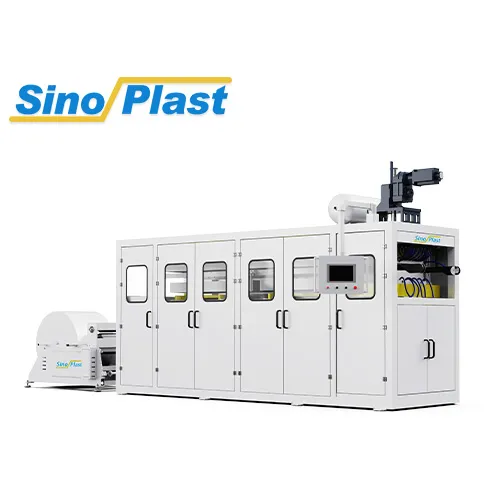
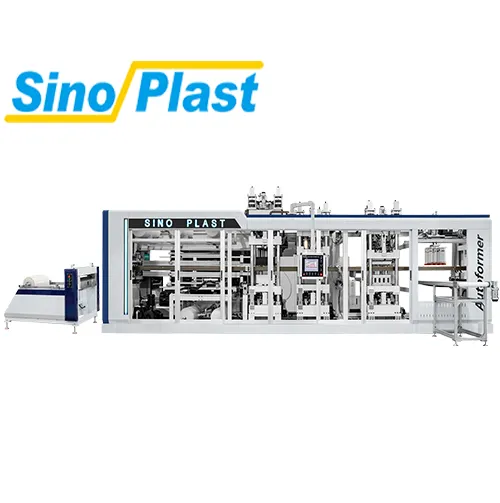
For converters looking for a reliable partner with a proven track record in both thin‑gauge and thick‑gauge applications, SINOPLAST offers a range of configurable forming and trimming systems built with European hydraulics and Chinese efficiency. Their 2025 lineup includes IR zone heating as standard, plus optional quick‑mold‑change and servo‑driven trim stations.
You can also request a free processing audit where their engineers review your current sheet waste and cycle times – no purchase required.
And if you need a deeper technical comparison between pressure forming and twin‑sheet technology, download the 2025 thermoforming spec guide that includes detailed power consumption tables and case studies from six Asian packaging plants.
References:
ASTM D7679 – Standard Test Method for Measuring Thermoforming Properties of Plastic Sheet
Plastics Technology (2024). “IR Heating vs. Ceramic: Real‑World Energy Data.” Retrieved from ptonline
SINOPAST internal white paper: “Changeover Time Reduction in Thin‑Gauge Thermoforming” (2024)
We are a professional plastic machinery provider in China.