
 Apr 27,2026
Walk into any large-scale catering kitchen that services airlines, school districts, or corporate campuses. The question they always ask me is not “how fast can you go” but “how do we keep the compartments from mixing when the sauce hits the hot rice?” Speed alone never solved that puzzle. The global disposable food container market is projected to exceed USD 85 billion by 2032, with meal prep and delivery driving much of that growth. Yet inside that number hides a stubborn fact: a lunch box line that runs at 45 cycles per minute but produces 8% warped lids or thin-walled compartments is not a production asset. It is a scrap generator wearing a speed label.
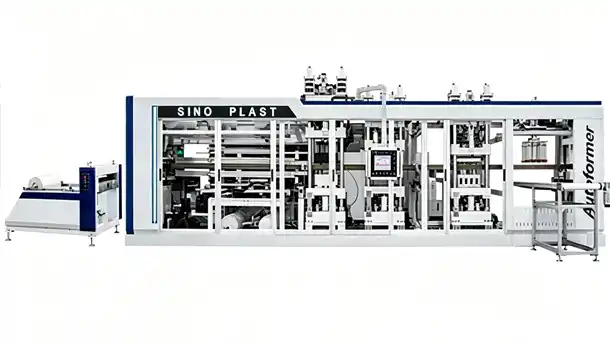
Every supplier will quote you a maximum cycle rate. 35 cycles per minute. 42 cycles. Some even whisper 50. But here is what they do not put in the brochure: that number usually comes from running a simple shallow cup with thin-gauge PET in perfect laboratory conditions. Throw a deep-draw lunch box with three compartments, an integrated hinge, and a lid snap feature into the same machine, and the sustainable output often drops by 25–35%.
I have watched a mid-sized meal prep company purchase a rapid thermoforming line based solely on the nameplate speed. Within three months, they discovered that the heating system could not keep the sheet temperature uniform across the full width needed for a 230 mm x 180 mm clamshell. The result? Compartment walls varied from 0.30 mm on one side to 0.52 mm on the other. Thick areas wasted material. Thin areas leaked. Their actual usable output was barely two-thirds of the promised figure.
What should you ask instead? Request sustained output data over an 8-hour shift, including material changeovers, mould cleaning, and quality sampling stops. A machine rated at 40 cycles per minute that delivers 32 cycles in real-world conditions is often a better investment than a 45-cycle machine that struggles at 30.
Polypropylene (PP) dominates the lunch box sector, and for good reason. It withstands microwave reheating up to 110°C, resists greasy foods better than PET, and offers excellent hinge durability for clamshell designs. But PP has a narrower processing window than PET. Run the sheet too cool, and the corners of deep compartments will thin out. Run it too hot, and the material sticks to the mould, creating drag marks that compromise the transparent lid area.
Sheet thickness is another hidden variable. For a standard two-compartment lunch box holding 400 grams of food, most manufacturers use sheet between 0.45 mm and 0.65 mm. Thinner sheets cycle faster but require more precise plug assist to avoid thin spots at the compartment bottoms. Thicker sheets offer better rigidity but demand longer heating times and higher forming tonnage, which reduces net output.
According to processing data from K 2025 industry presentations, switching from 0.50 mm to 0.45 mm sheet can increase forming speed by approximately 12% while reducing material weight by 10%. But only if the thermoforming equipment maintains consistent wall distribution across all cavities. One major European packaging firm reported that after optimising their heating profile and plug assist timing, they reduced average wall thickness by 0.07 mm without any increase in field failures — saving nearly 90 tons of resin annually on a single production line.
Here is the problem that keeps production managers awake. A clamshell lunch box is not just a tray with a separate lid. It is a single piece of plastic with a living hinge — a thin flexible section that must survive hundreds of open-close cycles without cracking. Get the hinge residence time wrong during forming, and the material crystallises unevenly. The hinge becomes brittle within weeks, not years.
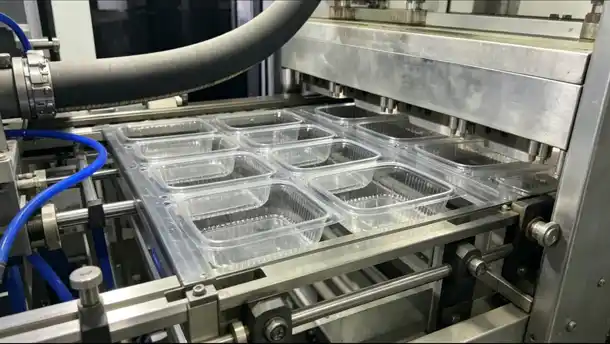
Solving this requires a forming station with independent temperature control across different mould zones. The hinge area needs slightly different cooling dynamics than the main compartment walls. Advanced machines achieve this through zoned cooling channels integrated into the mould base, combined with servo-driven plug assist that controls exactly how much material stretches into the hinge region.
I recently visited a bento box manufacturer who had tried three different forming systems before finally addressing the hinge problem correctly. Their solution was not a faster machine. It was a custom tooling design that incorporated variable wall thickness mapping — thicker at the hinge root, gradually thinning toward the compartment floors. The production speed remained unchanged. The scrap rate dropped from 11% to under 3%.
Thermoforming is an energy-intensive process. The heating ovens alone can consume 50–70 kW per hour on a mid-sized line. Over a three-shift operation, that adds up to serious money — and serious carbon emissions.
What most buyers never ask is kWh per 1,000 parts. A high-speed former with zoned infrared heating and intelligent power management can reduce energy consumption by 20–30% compared to older machines or poorly calibrated lines. Some newer systems now incorporate AI-powered heater mapping that adjusts power delivery based on real-time sheet temperature feedback, cutting idle consumption by switching off zones when no sheet is present.
At a typical European industrial power rate of €0.18 per kWh, reducing consumption by 25 kW per hour across 6,000 operating hours annually saves €27,000 per year — enough to cover the cost difference between a basic machine and a more efficient model within two years. These savings do not show up on the initial quote, but they show up on the P&L.
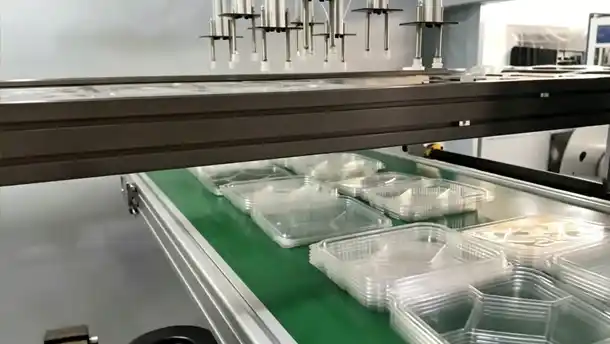
A cup forming machine and a lunch box line face different downstream challenges. Cups stack neatly by design. Lunch boxes — especially those with irregular shapes, compartments, or attached lids — do not. This means automated stacking and packing integration are not optional extras for high-volume production. They are essential.
Consider a line running at 35 cycles per minute with a 4-cavity mould. That is 140 lunch boxes per minute, or 8,400 per hour. Human operators cannot inspect, stack, and pack that volume reliably. You need robotic pick-and-place systems, vision inspection stations, and automated case packers integrated directly with the forming machine.
The best forming solutions are designed from the start with automation ports — standardised interfaces for downstream equipment, pre-programmed communication protocols, and physical mounting points for stacking end effectors. Retrofitting automation onto a machine that was never designed for it is expensive and often unreliable.
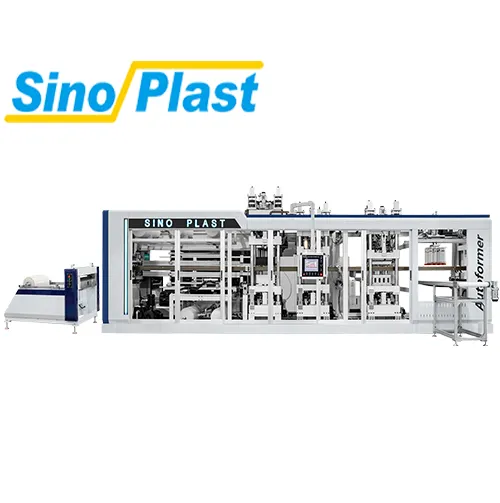
For a complete look at how different automation configurations integrate with forming equipment, explore the available system setups.
After reviewing dozens of failed equipment selections, I have compiled a short list of traps that catch even experienced buyers:
Trap #1: Ignoring mould changeover time. A machine that requires 90 minutes to swap moulds between product sizes kills your ability to run short batches or seasonal products. Look for quick-change mould systems with pre-heated stations and hydraulic clamping. Some advanced lines achieve changeovers under 15 minutes.
Trap #2: Undersizing the vacuum system. Large lunch boxes with deep compartments need substantial vacuum volume to pull the sheet into all corners before it cools. A vacuum tank that is too small causes incomplete forming — soft corners that collapse under top load. Ask for vacuum capacity measured in litres per minute, not just pressure.
Trap #3: Overlooking trim station integration. In-mould trimming (cutting the formed parts from the sheet during the forming cycle) is faster and cleaner than post-form trimming. But it requires precise alignment between the forming mould and the cutting steel rule. Cheaper machines often locate the trim station separately, adding a full cycle step and creating alignment drift over time.
Trap #4: Specifying speed without specifying material. A quote that says “40 cycles per minute on PP, 0.50 mm sheet” is meaningful. A quote that says simply “40 cycles per minute” is worthless. Always tie performance claims to specific materials and thicknesses.
Off-the-shelf thermoformers work fine for basic containers with simple geometry. But the moment you add compartments, living hinges, textured surfaces for grip, or integrated branding (debossed logos on the lid), standard machines hit their limits.
A custom-engineered forming line starts with your actual product specifications — not the other way around. The mould designer asks: What is the fill temperature of the hot entrée? How much top load will the bottom compartment need when stacked five high? Does the lid require a tamper-evident snap or a simple friction fit? These answers drive every decision: sheet thickness, heating profile, plug assist geometry, cooling channel layout, and trim timing.
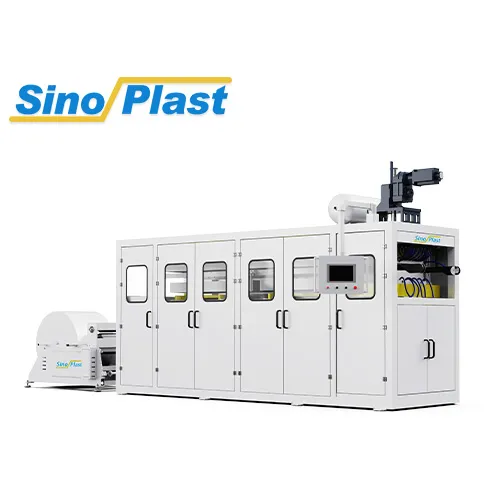
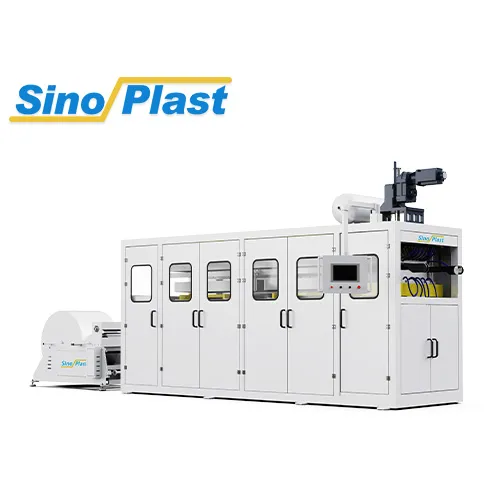
This is where a lunch box high speed thermoformer — purpose-built for this product category rather than adapted from general-purpose equipment — shows its value. The difference is not always visible on a spec sheet. It shows up in scrap rate reports, energy bills, and customer complaints about leaking compartments.
A forming press is a mechanical system. Bearings wear. Chains stretch. Heating elements degrade. The question is not whether maintenance will be needed — but how easy it will be.
Buyers rarely ask about accessibility during the selection process. Can you reach the lower heating elements without disassembling the sheet track? Is the vacuum manifold located where a technician can actually see the valves? Are spare parts available from local distributors, or do they ship from a single warehouse on another continent?
According to a 2024 survey of packaging plant managers, unplanned downtime costs an average of USD 2,300 per hour in lost production and labour. A machine that reduces mean time to repair (MTTR) by just two hours per month saves nearly USD 55,000 annually. This is why modular design matters — separate, replaceable subassemblies rather than integrated components that require full disassembly.
If you are currently evaluating suppliers, ask each one for a recommended spare parts list and typical lead times. Compare not just the machine price but the cost of keeping it running.
Before signing any purchase agreement, verify these six points:
Material versatility — Can the machine process PP, PET, PLA, and PCR blends without major reconfiguration?
Sustained output — Request 8-hour shift data, not peak cycle rates.
Energy consumption — Ask for kWh per 1,000 parts for your specific product dimensions.
Changeover capability — Time required for mould swap, including heating stabilisation.
Automation readiness — Standardised interfaces for downstream integration.
Support footprint — Local service availability and spare parts inventory.
A high-speed forming system is not a commodity. It is the core of your packaging operation. The wrong choice creates a cascade of problems — rejected batches, missed delivery windows, and hidden costs that erode margins month after month. The right choice becomes a competitive weapon: lower per-unit costs, faster response to market changes, and consistent quality that builds customer trust.
For detailed equipment specifications and customisation options, review the full product documentation.
We are a professional plastic machinery provider in China.