
 Jun 22,2026
You are comparing thermoforming machine quotes. The three-station model has a lower price tag. The four-station model costs more upfront. The obvious choice seems to be the cheaper machine — until you factor in what happens after installation.
The purchase price of a thermoforming packaging machine typically represents only 30–40% of its total cost over a five-to-seven-year lifecycle. The rest accumulates through energy consumption, labor, maintenance, downtime, and material waste.

This guide breaks down the total cost of ownership (TCO) for three-station and four-station thermoforming machines across all cost categories — not just the initial invoice — so you can make a decision based on long-term financial impact rather than upfront price alone.
Before comparing costs, it is essential to understand what each configuration does — and does not — include.
Three-station thermoforming machines typically handle forming, cutting, and stacking. The sheet enters, is heated and formed into shape, cut from the web, and stacked into finished parts. These machines are suitable for simpler geometries where products do not require punching or hole-making. Examples include basic cups, bowls, plates, and egg trays.
Four-station thermoforming machines add a dedicated punching station. The sequence becomes: forming → punching → cutting → stacking. The additional station allows for in-line creation of ventilation holes (fruit trays), drinking holes and hinge cuts (cup lids), and other perforation requirements.
The key difference is not just an extra station — it is the capability to perform operations that a three-station machine cannot do at all. If your product requires punching, a three-station machine is not a lower-cost alternative; it is an incorrect specification.
To see how station counts are implemented across different machine models, review the plastic thermoforming machine configurations overview.
Total cost of ownership for thermoforming equipment extends far beyond the purchase price. A comprehensive TCO analysis includes five categories:
| Cost Category | Three-Station | Four-Station | TCO Impact |
|---|---|---|---|
| Initial investment | Lower capital expenditure | Higher upfront cost | Four-station requires more capital |
| Labor cost | May require a secondary punching operation | Integrated punching reduces labor | Four-station saves on labor |
| Energy consumption | Lower power demand (fewer servos) | Higher power demand (additional punching servo) | Four-station consumes more energy |
| Maintenance | Simpler mechanics, fewer components | More complex, additional station to maintain | Three-station costs less to maintain |
| Scrap/waste | Higher if secondary operations misalign | Lower — integrated process maintains alignment | Four-station reduces material waste |
Three-station machines have a simplified mechanical structure, resulting in reduced capital expenditure. Typical cost savings range from 15–25% compared to equivalent four-station models. They also typically require 20–30% less floor space, which can reduce facility costs.
However, the initial investment calculation must include the cost of any secondary equipment. If your product requires punching and you purchase a three-station machine, you will need a separate punching press, adding to the total capital expenditure. A four-station machine integrates punching into the main equipment, eliminating this additional purchase.
This is where the cost comparison shifts significantly. A three-station machine producing products that require punching (fruit trays with ventilation holes, cup lids with drinking holes) cannot complete the job. Parts must be transferred to a separate punching press or handled manually for hole creation. This adds labor hours per shift, requires additional floor space, and introduces alignment challenges — holes may drift relative to formed features, increasing rejection rates.
A four-station machine eliminates the secondary handling step entirely. Parts move directly from forming into punching, with servo-driven synchronization maintaining hole position accuracy. Finished products exit the line directly. For high-volume production, the labor savings from eliminating secondary handling often exceed the higher upfront cost of the four-station machine.
Energy efficiency is a significant component of TCO. More efficient machines — though potentially more expensive upfront — can offer substantial savings on electricity over their lifespan.
Four-station machines consume more energy because they include an additional punching station with its own servo motor. However, the energy cost difference must be weighed against the energy that would be consumed by a separate punching press operating as a secondary process. If you need to run a separate press anyway, the incremental energy difference may be smaller than it first appears.
Regular maintenance is crucial to keep thermoforming equipment running smoothly. Machines designed for easy maintenance — with accessible components and user-friendly diagnostic systems — minimize downtime.
Three-station machines have fewer moving parts and simpler mechanics, which generally translates to lower maintenance costs and less frequent repairs. Four-station machines have additional complexity — an extra station with its own servo motor, tooling, and control systems. This means more components that can require maintenance over time.
However, downtime cost is not just about repair frequency. If a three-station machine requires a separate punching press and that press breaks down, the entire production line stops or produces unfinished parts. A four-station machine consolidates risk into a single integrated system — when it runs, all operations run.
The quality of products produced by thermoforming equipment directly impacts cost-effectiveness. High-quality products have fewer defects, meaning less waste and higher customer satisfaction.
For punched products, alignment is the critical quality factor. In a three-station + separate punching press setup, alignment depends on manual fixturing or secondary registration systems — both of which introduce variability. Misaligned holes mean rejected parts.
In a four-station machine, the punching station is servo-synchronized with the forming station. This maintains alignment across millions of cycles, reducing rejection rates and improving yield. Higher yield means more salable items from the same amount of raw material.
The TCO comparison depends heavily on your product requirements and production volume.
Your products do not require punching (solid cups, basic trays, bowls, plates)
Production volume is low to moderate
You have existing punching equipment or can outsource punching
Floor space is limited, and a smaller footprint is valuable
Your products require punching (fruit trays with ventilation holes, cup lids with drinking holes, or hinges)
Production volume is high — labor savings from eliminating secondary handling add up quickly
Quality requirements are tight — integrated alignment reduces rejection rates
You want a single integrated line with minimal manual intervention
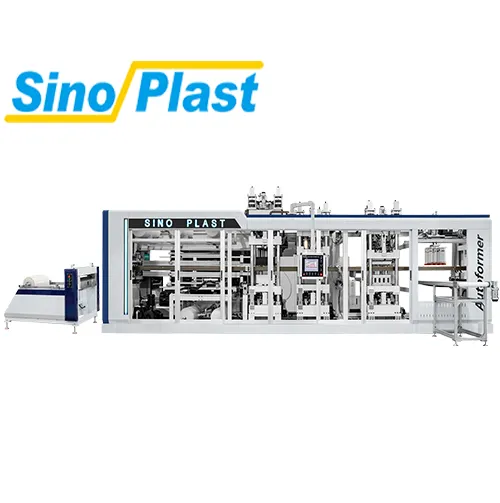
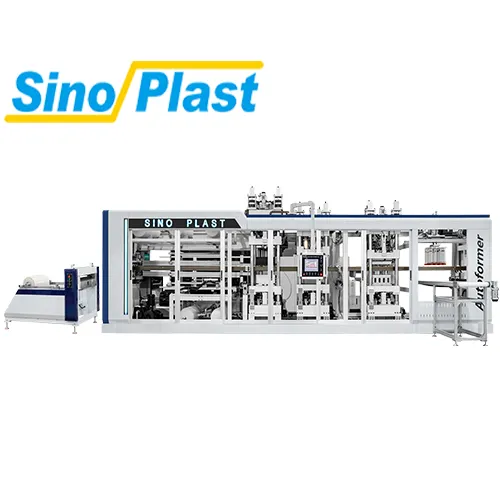
According to Sinoplast's technical documentation, a four-station thermoforming machine integrates four stations: forming, punching, cutting, and stacking. This integration means finished parts exit directly — no secondary handling, no manual transfer, no alignment issues.
The practical trade-off: a three-station machine has a lower initial equipment cost. However, if your product requires punching, the total cost of ownership for a three-station machine must include the separate punching press, additional labor, floor space for the second machine, and higher rejection rates from alignment variability. In many cases, the four-station machine delivers lower TCO despite a higher upfront cost.
Use this five-step framework to evaluate the total cost of ownership for your specific production scenario.
Do your products need holes, slots, or hinge cuts?
If yes, a three-station machine requires secondary punching equipment
If no, three-station is viable
Calculate parts per year
Multiply by the labor time per part for secondary punching (if applicable)
Convert to labor cost at your local wage rate
Compared to the additional cost of a four-station machine
Estimate rejection rate for three-station + separate punching (typically higher due to alignment variability)
Estimate rejection rate for four-station integrated punching (typically lower)
Calculate the cost of rejected material and lost production time
Obtain power consumption specifications for both configurations
Multiply by your local electricity rate and expected operating hours
Compare annual energy costs
Estimate annual maintenance for each configuration
Factor in downtime cost per hour (lost production value)
Compare total maintenance + downtime cost
A manufacturer produces 2 million ventilated fruit trays per month. Each tray requires 8 ventilation holes. Current operation uses a three-station machine plus a separate punching press with two operators per shift, transferring and aligning trays.
TCO analysis: The labor cost of two operators per shift, three shifts per day, adds significant annual expense. Rejection rate from misaligned holes averages 4%. A four-station machine would eliminate both operators and reduce rejection rate to under 1%. The annual savings in labor and material exceed the additional upfront cost of the four-station machine within 18 months.
A manufacturer produces 200,000 solid PS cups per month. Cups have no holes, no hinges. The current three-station machine runs reliably.
TCO analysis: No punching requirement means no secondary operation. The three-station machine is the appropriate configuration. Upgrading to a four-station system would add cost without providing any benefit. Three-station delivers lower TCO.
A packaging converter produces both solid cups (60% of volume) and hinged lids (40% of volume). Lids require drinking holes and hinge scoring.
TCO analysis: The three-station cannot produce lids. The converter could purchase a three-station machine for cups and a separate four-station machine for lids — doubling capital expenditure. Alternatively, a single four-station machine can run both: cups with the punching station idle or bypassed, lids with punching active. The single-machine approach delivers lower TCO despite the higher cost of a four-station machine compared to a three-station one, because it avoids purchasing two separate machines.
TCO is not just about dollars. Operational factors affect long-term cost and should inform your decision.
Flexibility: A four-station machine can produce both punched and non-punched products. A three-station machine cannot produce punched products. If your product mix may evolve, the four-station machine provides future flexibility.
Setup time: Sinoplast thermoforming machines include a mold parameter saving function. Once initial setup and debugging are completed, the machine stores parameters for future use, enabling quick setup by simply pressing start. This feature applies to both three-station and four-station models, reducing changeover time and improving overall equipment effectiveness regardless of configuration.
Labor skill requirements: A fully integrated four-station line requires fewer operators. However, the operators who run it need to understand the integrated process. A three-station + separate punching setup requires operators for both machines, but may allow simpler training for each individual station.
Spare parts inventory: Four-station machines have additional components — more servo motors, more tooling, more control systems. Spare parts inventory costs are higher. However, if you need to maintain spare parts for a separate punching press anyway, the incremental difference may be smaller.
You now have a framework for evaluating total cost of ownership across three-station and four-station thermoforming machines:
Three-station offers lower upfront cost, simpler maintenance, and smaller footprint — but cannot handle punching
Four-station requires higher initial investment but eliminates secondary handling, reduces labor, improves alignment, and lowers rejection rates for punched products
The key TCO decision factor is not the machine price alone, but whether your products require punching. If they do, a three-station machine is not a lower-cost alternative — it is an incorrect specification that will require additional equipment, labor, and floor space, and will produce higher rejection rates.
Once you have confirmed your product’s punching requirements and calculated the TCO for your specific volume and labor rates, comparing the detailed specifications of available thermoforming machines becomes the logical next step.
Three-Station vs Four-Station Thermoforming: Which Reduces Downstream Handling?
Calculating Thermoforming Line ROI: A Practical Framework
Energy Cost Analysis for Thermoforming Equipment
Maintenance Planning for Multi-Station Thermoforming Machines
Sep 01,2026
We are a professional plastic machinery provider in China.