
 Jun 16,2026
You are setting up a cup production line, but you cannot finalize the equipment specification until you answer one fundamental question: Will you run PET or PP? The choice is not trivial. Each material requires different heating profiles, delivers different cycle speeds, and produces cups with different end-use characteristics. Selecting the wrong material for your market can mean either slow production or cups that fail in your customers‘ hands.
This guide compares PET and PP specifically for plastic cup thermoforming applications. You will learn how each material behaves in the forming process, which products each material suits best, and what machine features matter for each, without pricing comparisons or promotional claims.
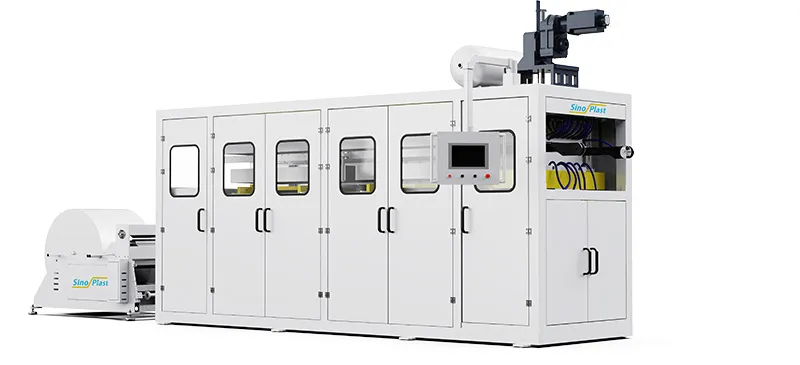
PET (Polyethylene Terephthalate) and PP (Polypropylene) are both widely used in thermoforming cup production, but their material properties lead to very different processing requirements.
PET is known for its crystal-clear transparency, high impact strength, and good barrier properties for preserving beverage freshness. However, PET is hygroscopic — it absorbs moisture from the environment. During processing, moisture content should not exceed 0.02%; otherwise, molecular degradation and surface defects such as smearing may occur. This means PET sheet must be properly dried before forming.
Key processing characteristics:
Lower heating temperature required compared to PP
Faster cycle speeds possible due to lower energy input
Higher density means more material weight per container
Shrinkage can occur if cooling is inadequate
PP offers excellent heat resistance (up to 120°C), making it suitable for hot-fill applications and microwave-safe containers. It is more forgiving of moisture and does not require pre-drying like PET. PP is valued for its durability and chemical resistance.
Key processing characteristics:
Higher heating temperature required
Slower cycle speeds than PET at the same machine settings
Lower density means less material weight per container
Can produce living hinges for lid applications
| Property | PET | PP |
|---|---|---|
| Transparency | Crystal clear | Translucent to opaque (can be clarified with additives) |
| Max service temperature | ~70°C (softens above) | ~120°C |
| Moisture sensitivity | High — requires pre-drying | Low |
| Relative cycle speed | Faster (lower heating requirement) | Slower |
| Material density | Higher (more weight per cup) | Lower (less material per cup) |
| Impact strength | High | Good |
| Typical applications | Cold drinks, bottled beverages, clear packaging | Hot drinks, dairy cups, microwaveable containers |
PP is the most popular choice for hot-fill dairy cups, while PET offers the best clarity for cold drink cups.
Most modern cup thermoforming machines can process both PET and PP, but the same machine will run them at different speeds and with different settings. The key is understanding how your chosen material affects production parameters.
Heating requirements differ significantly. PET sheet requires lower heating temperatures than PP material, so it can achieve faster operating speed. For a typical cup machine running at 15-32 cycles per minute, switching from PP to PET may allow operation toward the higher end of that range without changing mechanical components. The exact speed achievable depends on sheet thickness and product depth; thinner sheets and shallower products allow faster cycles in either material.
Forming area considerations. Larger forming layouts (e.g., 760 x 540mm) allow more cavities per cycle, which boosts production output. The number of cavities you can run — for example, 24 cavities for a 75mm diameter cup in a 760 x 320mm layout, or 32-40 cavities in a 760 x 540mm layout — applies to both materials. Higher clamping force may be required for PET and PP materials to ensure consistent results across multiple cavities.
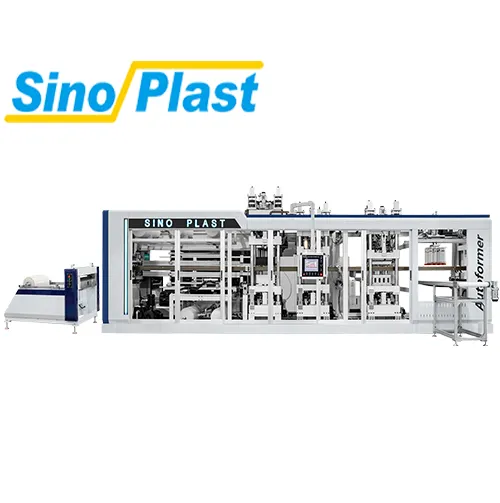
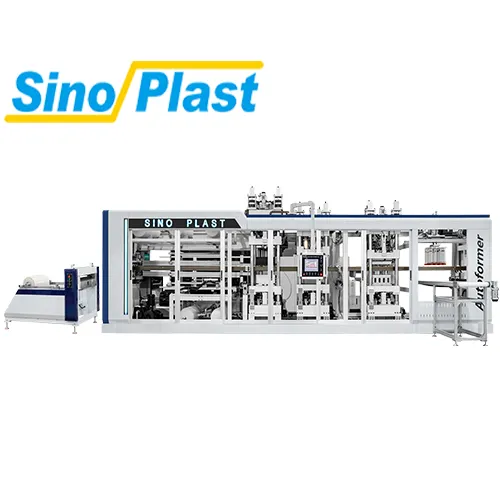
To see how forming area dimensions affect cavity count and output across different materials, review the plastic cup machine configurations overview.
The best material depends on what you are producing and where those products will be used.
Cold beverage cups. PET‘s crystal clarity makes it the preferred choice for cold drinks — bottled water cups, iced coffee, smoothies, and juice cups where product visibility matters.
Premium cold packaging. The high impact resistance and glass-like transparency convey quality for retail applications.
Recycling-focused markets. PET is highly recyclable (resin code #1) and faces fewer regulatory restrictions than PS. In the European Union, PET food packaging must contain at least 30% recycled content by 2030, increasing to 50% by 2040. For packaging other than PET (including PP), the recycled content requirement starts at 10% in 2030. If your market demands high recycled content, PET is currently ahead in both availability of recycled material and regulatory mandates.
Hot beverage cups. PP can withstand temperatures up to 120°C, making it suitable for coffee cups, tea cups, and other hot-fill applications where PET would soften and deform.
Dairy cups. Yogurt cups, pudding cups, and ice cream containers are frequently made from PP due to its durability, lightweight nature, and compatibility with filling and sealing lines.
Microwaveable containers. Products intended for reheating require PP or CPET (crystallized PET), not standard amorphous PET.
Living hinge lids. If your product line includes lids that need to open and close repeatedly without breaking, PP‘s hinge performance is superior to PET.
Lightweight packaging priorities. PP has a lower density than PET; 1kg of PP will make about 161 containers, while 1kg of PET makes only about 109 containers of similar functionality. For lightweighting initiatives, PP has an inherent advantage.
According to a 2025 market report, the global thermoformed plastic products market was valued at US$14.6 billion in 2025 and is projected to reach US$21.8 billion by 2032, growing at a CAGR of 5.9%, driven largely by demand for lightweight, cost-effective packaging solutions across the food and beverage industry.
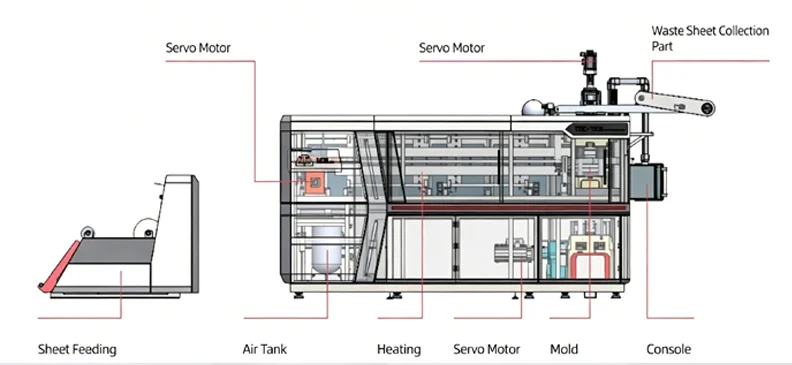
Use this checklist to evaluate which material aligns with your production goals, end-market requirements, and operational constraints.
Cold drinks only (juice, water, iced coffee) → PET is suitable
Hot drinks (coffee, tea) or hot-fill processes → PP is required
Microwave reheating → PP or CPET required (standard PET not suitable)
Crystal clarity critical (beverage branding, fruit cups) → PET is the clear choice
Clarity not a priority → PP is acceptable; clarified PP grades approach PET-like transparency
Maximizing cycles per minute → PET runs faster at the same machine settings
Speed less critical than heat resistance → PP remains viable
EU market with recycled content mandates → PET has higher mandated targets (30% by 2030 vs. 10% for PP in non-PET packaging)
Markets without strict mandates → both materials viable; PP offers lightweighting advantages
Cup production only → both materials supported by the same machine
Cup + lid production (with living hinges) → PP required for hinge function
A manufacturer supplies clear cups for a national bubble tea chain. The product is served cold. Transparency is essential for branding and presentation. The target market has no imminent hot-fill requirement.
Material fit: PET is the appropriate choice. The machine can run PET at faster cycle speeds, maximizing output. The crystal clarity meets branding requirements. Down the line, if the customer introduces hot beverages, the producer would need to evaluate PP or maintain separate production lines.
Machine considerations: PET‘s lower heating requirement means faster cycles, but the machine must have precise temperature control to avoid overheating and crystallization, which would reduce clarity. Pre-drying equipment is required for PET sheet storage.
A manufacturer produces 150ml yogurt cups for European supermarket private labels. The product is cold-filled. The buyer demands the packaging contain 30% PCR (post-consumer recycled) content by 2030.
Material fit: PET currently has an established recycled content supply chain, with mandates explicitly requiring 30% recycled content in PET food packaging by 2030. For PP, the mandated recycled content for non-PET food contact packaging is 10% starting in 2030, increasing to 25% by 2040 — a lower requirement but also a less mature recycled supply chain.
Machine considerations: The machine must handle the thermal properties of recycled-content sheet, which can differ from those of virgin material. A production line with flexible heating zone control and recipe storage for different material batches is advantageous.
A converter produces cups for both hot coffee (to-go) and cold juice (on-shelf) for multiple brands. Monthly volume is split 60% cold, 40% hot.
Material fit: Neither single material covers both applications. PET cannot handle hot coffee. PP can handle cold juice but lacks PET‘s crystal clarity for premium cold beverage applications. The converter needs either two production lines — one optimized for PET, one for PP — or a single line that can switch between materials, accepting the speed and quality trade-offs.
Machine considerations: A thermoforming machine that supports both PET and PP is available, but changeovers require adjusting heating profiles and temperatures. Faster changeover features — such as recipe storage for different materials — reduce downtime between production runs.
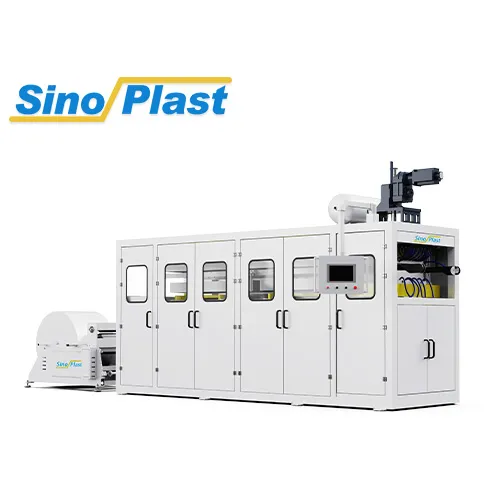
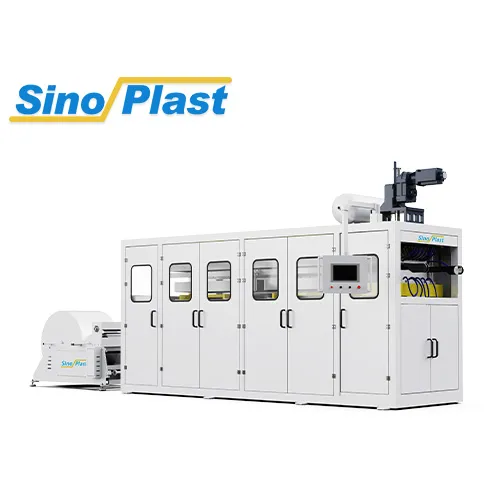
For manufacturers producing multiple product categories — cups, lids, and trays — understanding how machine setups accommodate different raw materials is essential. Explore sinoplast plastic cup making machines to match machine configurations to your production applications.
Environmental considerations increasingly drive material decisions. Two factors stand out for PET vs PP comparison.
Recycled content mandates: The EU Packaging and Packaging Waste Regulation (PPWR) requires specific recycled content percentages by 2030. For contact-sensitive PET packaging: 30% recycled content. For contact-sensitive packaging made of plastics other than PET: 10% recycled content. These targets increase by 2040 — PET to 50%, other plastics to 25%.
Material efficiency: PP‘s lower density means significantly less material is required to produce the same number of containers. A recent life cycle assessment comparing PET and PP trays found that PP’s lower density allows more containers per kilogram of raw material, affecting both cost and environmental footprint. However, end-of-life considerations and recycling infrastructure vary by region.
If your target market includes the EU, the higher PET recycled content target may make PET more attractive for compliance reasons, provided you can source adequate recycled-content sheet. If your priority is reducing material usage per container, PP‘s lower density provides an advantage.
You now have a framework for choosing between PET and PP based on your product requirements, target applications, and regulatory environment:
PET for cold drinks, clarity-critical applications, and markets with high recycled content mandates
PP for hot drinks, dairy cups, living hinge lids, and lightweighting priorities
Both materials possible if your machine has recipe storage and flexible heating controls
The material decision is not about which plastic is “better” — both have established roles in the industry — but about which fits your specific production profile. Once you have determined whether PET, PP, or both suit your product line and target markets, comparing specific machine specifications for your chosen material becomes the logical next step.
PET Sheet Pre-Drying Requirements: Why Moisture Control Matters
Living Hinge Design for PP Thermoformed Lids
Recycled Content in Thermoforming: Sourcing PCR Sheet and Adjusting Machine Parameters
Cycle Speed Optimization: Material, Thickness, and Cooling Time Relationships
Forming Area and Cavity Count: Calculating Output for Different Cup Sizes
Sep 01,2026
Aug 27,2026
We are a professional plastic machinery provider in China.