
 Aug 20,2026
You are evaluating thermoforming equipment for your packaging production. Some suppliers offer single-station machines with straightforward operation. Others recommend multi-station systems with higher output. The price difference is significant, but the choice goes far beyond initial cost—it affects your production capacity, changeover flexibility, and cost per part.
Single-station thermoforming machines process one cycle of forming, cooling, and trimming in a single location. Multi-station machines split these operations across two or more stations, allowing parallel processing. This guide compares both configurations across cycle time, tooling investment, changeover complexity, and operational fit to help you determine which approach suits your production requirements.
The fundamental distinction lies in how each machine handles the forming cycle. In a single-station thermoforming machine, all stages of the process—heating, forming, and cutting—take place within one station. The plastic sheet moves into position, completes every step, and then advances. This sequential approach is straightforward and well-suited to applications where simplicity and precision in one location matter most.
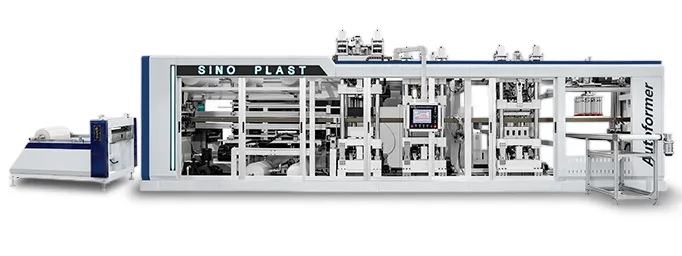
A multi-station thermoforming machine distributes these stages across separate stations that operate simultaneously. While one section of the sheet is being formed, another is being heated, and a third is being cut. This parallel processing means the machine is never waiting for a single step to finish before the next begins.
Station architecture overview:
| Configuration | Process Flow | Typical Stations |
|---|---|---|
| Single Station | All steps occur sequentially in one location: heating → forming → cooling → trimming | 1 station |
| Multi-Station (3-station) | Steps distributed: heating/forming, cutting, stacking | 3 stations |
| Multi-Station (4-station) | Steps fully separated: preheating, forming, cutting/punching, stacking | 4 stations |
Cycle time is the most visible differentiator. A typical single-station machine might achieve 8–12 cycles per minute for a small cup, while a three-station machine can reach 20–30 cycles per minute for the same part. Four-station systems can achieve 25–35 cycles per minute with dedicated stations enabling continuous operation.
| Parameter | Single Station | Multi-Station (3-station) | Multi-Station (4-station) |
|---|---|---|---|
| Typical cycle time | 5–15 seconds | 2–6 seconds | 2–4 seconds |
| Typical output (cups/min) | 8–12 | 20–30 | 25–35 |
| Tooling cost factor | 1x (baseline) | 2–3x | 3–4x |
| Changeover time | 20–45 min | 45–90 min | 45–90+ min |
Why this matters: For high-volume production, the output advantage of multi-station systems compounds significantly. A manufacturer requiring 10 million cups annually would need multiple single-station machines or one multi-station system with higher output.
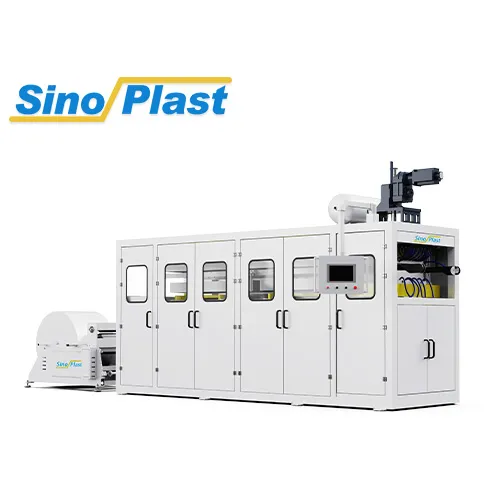
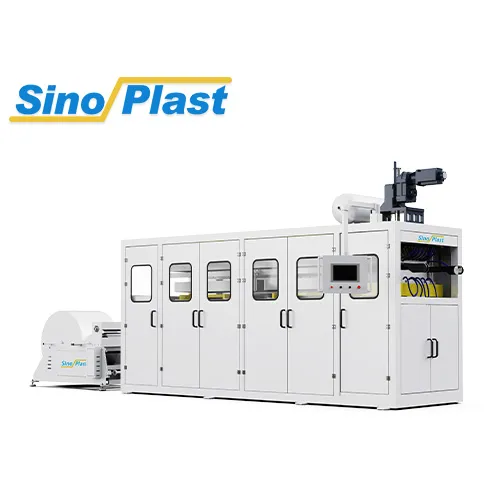
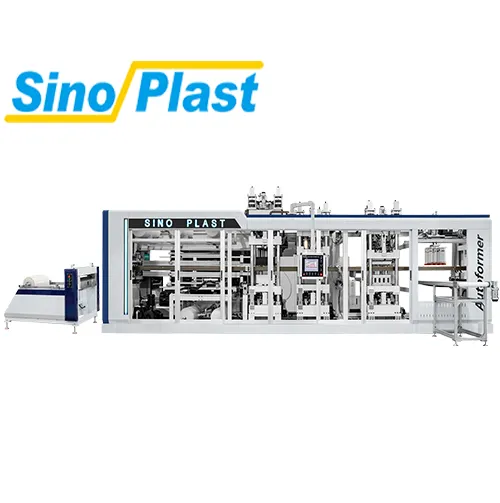
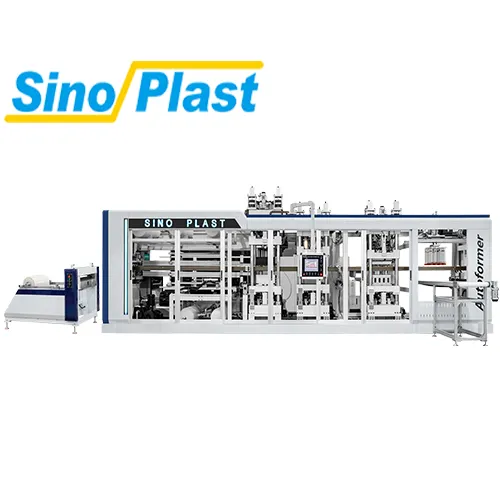
To see how station configurations are implemented in actual cup-making equipment, review the plastic thermoforming machine configurations overview.
Changeover time is critical for facilities running multiple product SKUs. Single station machines typically require 20–45 minutes to change molds and adjust parameters. Multi-station machines often require 45–90 minutes because each station must be reconfigured individually and timing relationships reset.
| Changeover Factor | Single Station | Multi-Station |
|---|---|---|
| Typical changeover time | 20–45 min | 45–90 min |
| Operator training | 2–4 weeks | 6–8 weeks |
| Setup complexity | Lower | Higher—requires synchronizing stations |
What this means for your production: A single-station machine is more flexible for operations with frequent product changes. Multi-station machines excel in dedicated, high-volume environments where changeovers are infrequent.
The initial tooling cost differs significantly between configurations. Single-station molds typically cost less because they require simpler alignment systems and less robust thermal management. Molds for single-station machines can utilize cast aluminum without integrated water channels, while multi-station molds often incorporate guide pins, tapered locators, and temperature control passages.
Tooling cost factors:
Single station: Lower absolute cost (25-35% less than multi-station tooling)
Multi-station: Higher tooling investment but lower per-part amortized cost at high volumes
For high-volume production, the per-part tooling cost depends primarily on production volume, not absolute mold price
How each machine manages the plastic sheet affects product quality and waste. In single-station machines, the forming tool performs all movements in one place, which concentrates mechanical stress on fewer components. The stationary sheet provides better sag control for deep-draw parts and better registration for multi-cavity molds.
Multi-station machines distribute mechanical load across multiple stations, which can reduce peak stress on individual components. However, they also introduce greater mechanical complexity. Multi-station systems require careful thermal management to ensure the sheet arrives at the forming station at exactly the right temperature, since any variation introduced in earlier stations will carry through.
Single station machine—best fit when:
Annual volume is below approximately 60,000 parts
Product mix includes more than ten distinct part numbers requiring regular mold changes
Parts involve deep draws or fine surface textures demanding stationary sheet forming
Initial capital constraints limit equipment budget
Changeover frequency is high
Multi-station machine—best fit when:
Annual volume exceeds 100,000 parts
Production is dedicated to running identical part numbers for extended periods
Facility operates 24/7 and prioritizes continuous output
Lower per-part labor and energy costs are important
Integration with robotic handling and automated production cells is planned
A new packaging manufacturer is launching with 3-5 cup sizes and a monthly volume of 200,000-300,000 parts. The operation needs flexibility to test different products and adjust to market demand.
Configuration fit: A single-station machine provides lower initial investment, faster changeovers (20-45 minutes), and simpler operation. If the business grows to high-volume production, the single station can serve as a development tool, with molds transferred to multi-station lines after demand stabilizes at volume.
A manufacturer produces standard yogurt cups for a major dairy customer. Annual volume exceeds 10 million units. Production runs the same product 24/7 with minimal changeovers.
Configuration fit: A three‑station or four‑station plastic thermoforming machine delivers significantly higher throughput — 20‑35 cycles per minute, compared with 8‑12 cycles for a single‑station unit. The higher upfront investment and tooling costs are offset by lower per‑part labor and energy costs, with payback typically achieved within 12 to 24 months.
Different product categories—cups, lids, trays—have varying production requirements. For an overview of which configurations suit which applications, see Sinoplast plastic thermoforming machines applications.
You now have a framework for evaluating single-station vs multi-station thermoforming machines:
| Consideration | Choose Single Station If | Choose Multi-Station If |
|---|---|---|
| Production volume | Below 60,000–100,000 parts/year | Above 100,000 parts/year |
| Product mix | High variety, frequent changes | Dedicated, long runs |
| Capital budget | Limited | Available for higher investment |
| Changeover speed | Critical | Less critical |
| Labor cost per part | Less important | Important |
The key is to match machine architecture to your actual production profile rather than selecting based on price alone. A single-station machine is not a compromise—it is the right choice for flexibility and low-volume production. A multi-station machine is not overkill—it is the right choice for high-volume continuous operation.
Once you have determined your required output and changeover frequency, comparing specific equipment specifications—forming area, heating zone configuration, and servo precision—becomes the logical next step.
Three-Station vs Four-Station Thermoforming: Key Differences
Calculating Thermoforming Line ROI: A Practical Framework
Changeover Optimization for Multi-Station Thermoforming Lines
Material Handling in Thermoforming: Sheet Feed and Tension Control
We are a professional plastic machinery provider in China.