
 Nov 21,2026
A thermoforming machine's price is built from five blocks: the frame and number of stations, the servo and control package, the heating system, the tooling, and the scope the supplier includes after delivery. Forming area, draw depth, cycle target, and material set the size of each block. Two quotes for the same 780 × 650 mm layout often differ more in servo count, heater brand and scope than in steel weight.
A buyer sends one product drawing to three suppliers and gets three numbers that sit far apart. The instinct is to treat the middle figure as the fair one. In most cases the gap is not margin; it is scope.
The specification sheet is where it starts. “780 × 650 mm, four stations, PP/PS/PET” can describe machines that share a working area and almost nothing else. One supplier counts eight servo axes. Another keeps pneumatic cylinders for cutting and stacking and reserves servos for forming. One quotes German ceramic heaters; the other quotes a domestic element bank. One runs a mold trial before shipment; the other ships the machine and leaves the first setup to the buyer's team.
Convert both offers into the same five blocks before comparing the totals. A quote that cannot be broken down this way usually means the supplier has not priced the scope in a comparable form.
Every thermoforming machine quotation, whatever the model name, resolves into the same structure. The blocks differ in size by product and by supplier, but few of them can be removed without changing what the machine can do.
| Block | What it covers | What moves the number | What to request in writing |
|---|---|---|---|
| Frame and stations | Base, pillars, platens, chain rails, station sequence | Forming area, draw depth, station count, platen size | Frame weight, platen size, station sequence |
| Motion and control | Servo motors and drives, PLC, HMI, wiring, safety circuit | Number of servo axes, kW per axis, drive brand | Axis-by-axis motor list with kW and brand |
| Heating | Ceramic heaters, zones, temperature control, oven insulation | Heater brand, zone count, oven size, warm-up time | Heater make, zone layout, documented warm-up time |
| Tooling | Mold, cavities, punch tool, cutting rule, polishing | Cavity count, mold material, product geometry | Whether tooling sits inside or outside the price |
| Scope after delivery | Factory acceptance test, manuals, packing, freight terms, installation, training, spares, warranty | Engineer days on site, spares list, warranty length, Incoterm | A written scope annex, not a verbal promise |
Most quotations compress blocks two to five into a single line called “configuration”. That is why two totals for the same machine can look unrelated until the motor list, the heater make and the scope list are laid side by side.
The frame is sized by forming area and by the force needed to stretch sheet at forming temperature. In the 780 platform, published layouts run 780 × 540 mm on the standard version and 780 × 650 mm on the wider one, with a maximum draw depth of 140 mm across the four-station range. The cup platform in the same family runs 760 × 320, 760 × 450 and 760 × 540 mm, with a 160 mm draw available on request.
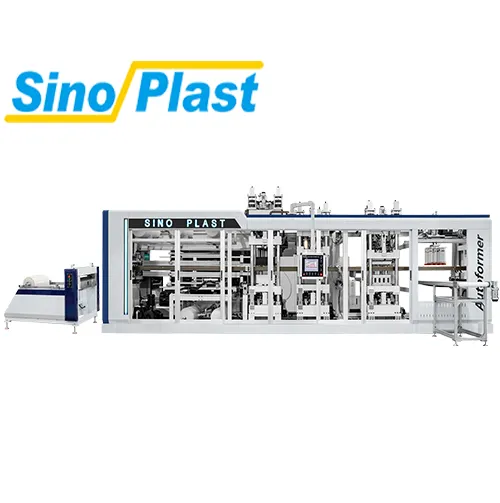
Station count changes the frame. A four-station machine adds punching between forming and cutting: a 14 kW servo axis on the SPB-780D and SPM-780D, a heavier platen, and a longer base to carry it. Published machine weight for the same forming area moves from about 17 t on the three-station version to about 21 t on the four-station version. Two costs follow. The invoice rises, and so does freight, because ocean freight, lifting and insurance are priced on weight and volume rather than on machine count.
If the product needs holes or hinge cuts, the punching station is not an optional extra — the alternative is a second press on the floor. The station sequence and forming area for each build are listed on the available plastic thermoforming machine configurations page, and the lifetime comparison between the two layouts is handled separately in a five-year total cost of ownership comparison.
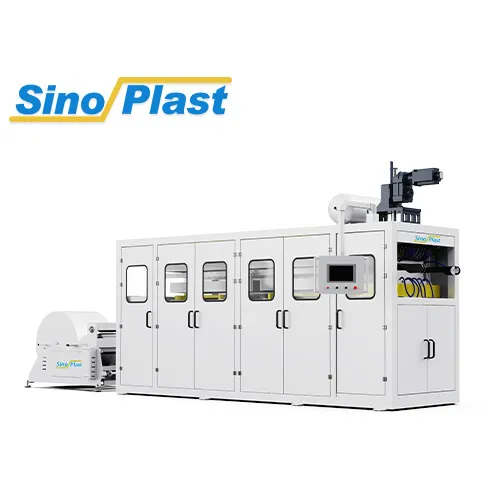
Servo content is the clearest dividing line between two machines that look alike. The SPF-780 Four Station Plastic Thermoforming Machine uses eight Siemens servos: six at 7 kW for forming, stretching and cutting, and two at 3.5 kW for feeding and stacking, with a 14 kW punching axis added on the four-station version. On the cup platform the lower-mould drive is 14.1 kW on the 760 × 320 version and 20.4 kW on the 760 × 450 version, with a 4.4 kW feed axis and a 5.5 kW plug assist.
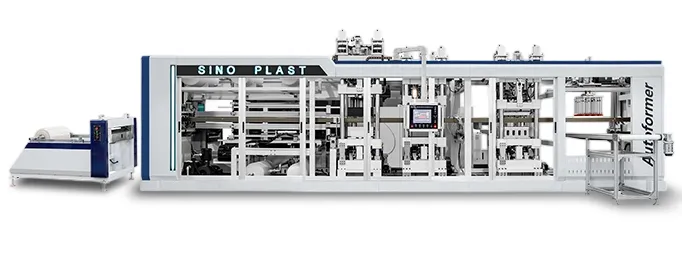
Each servo axis replaces a pneumatic or mechanical motion with a programmable one. That buys repeatability at speed — published running speeds are 15 to 32 cycles per minute on the cup platform and 35 to 40 on the 780 four-station range — and it removes some compressed-air demand from the plant. It also adds drives, encoders, cabling and commissioning time, which is what the buyer sees on the invoice.
A three-servo machine and an eight-servo machine are not the same product at different prices. If the target is 30 cycles per minute on thin PP, pneumatic cutting and stacking will not reach it, and the servo package is not an item to negotiate away. The reverse holds too: a buyer running thick sheet at 15 cycles per minute pays for axes that will never be pushed.
Heating is the block where purchase price and running cost pull against each other. In Sinoplast, the heater bank is German Elstein ceramic; a competing offer may use a domestic element set at a lower price. The difference does not show up in the invoice alone. Element quality, zone layout, and independent upper and lower control decide how much electricity becomes useful heat at the sheet, and warm-up time decides how much of the shift is lost before the first good part.
Ask for the heater make, the number of control zones, whether the upper and lower banks are controlled separately, and the warm-up time the supplier expects in production. A line that reads “ceramic heaters” without a brand and a zone count is not a line that can be compared.
Molds are usually priced separately from the machine, which is why they are the most common omission in a first comparison. On the cup platform, a 75 mm cup fits 24 cavities on a 760 × 320 mm layout and 32 to 40 cavities on a 760 × 450 mm layout. Cavity count raises mold price, but it also raises output and the load the press carries, so the right number is set by the output target and the sheet thickness, not by the mold quote alone. The plastic cup making machine range lists the cavity examples with each forming area.
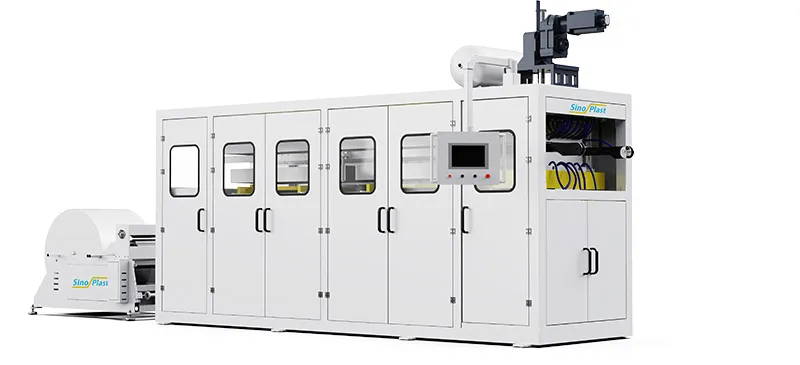
One design detail belongs in the tender. Sinoplast designs a single mold to produce cups of different capacities as long as the top diameter stays the same, which defers the second tool purchase when a customer adds a size. Whether another supplier will do the same has to be asked, not assumed.
Four questions close the tooling block: is the mold inside or outside the machine price, who owns the drawing, who pays for the trial run and any rework, and what is the tooling lead time against the machine's delivery date.
The last block is what happens between the factory gate and the first saleable pallet. It covers the factory acceptance test, manuals and their language, electrical certification for the destination market, packing, freight terms, engineer days on site, operator training, the recommended spare parts kit, and warranty terms.
A quotation that omits installation is not a cheaper machine. It is a machine plus an open-ended project, and the open end is carried by the buyer: rigging, levelling, utility connection, first mold setup, and the trial and error that follows when the first sheet does not form as expected. The scope list should enter the purchase order line by line rather than be agreed in conversation.
The decisions below account for most of the spread between two quotes for the same product. The invoice effect and the running effect rarely point in the same direction.
| Decision | Effect on the quotation | Effect on running cost | When it is justified |
|---|---|---|---|
| Three stations to four | Punching axis, heavier platen, longer frame; about 4 t more to ship | Removes a second press and the labour around it | Product needs holes, slots or hinge cuts |
| 780 × 540 mm to 780 × 650 mm | Larger platen, frame and heater bank | More cavities per cycle, but more scrap per wasted cycle | Bigger parts or a higher cavity count in one mold |
| Pneumatic to servo cutting and stacking | Extra drives, encoders and cabling | Faster and more repeatable, lower air demand | Cycle target near the top of the published range, or tight cut tolerance |
| Domestic heaters to branded ceramic | Higher invoice | Lower energy per part and shorter warm-up, to be verified against supplier data | Machine runs more than one shift |
| Single-cavity to multi-cavity mold | Higher tooling cost | Lower cost per part up to the load limit of the press | Output target justifies the cavities |
| Manual to automatic stacking | Extra station and servo | Fewer operators, less damage between cutting and packing | Labour cost or hygiene requirements are high |
| Buying sheet to running an extrusion line | Step change in capital | Sheet cost and thickness consistency move in-house | Sheet consumption is large, steady and thickness-critical |
The machine price is one line in the project budget. The rest lands before the first cup is packed.
Run the comparison in this order. It takes about an hour per quotation and removes most of the surprises that otherwise appear after the deposit.
The invoice answers what the machine costs. It does not answer what a thousand cups cost, and that is the number a project is approved on. The arithmetic is short enough to run before signing.
Cost per 1,000 parts = (depreciation + energy + labour + material + scrap + tooling amortisation) ÷ thousands of good parts produced per hour.
The example below uses published machine parameters and clearly marked example rates. Replace the rates with your own resin, power and wage figures; the structure of the result will not change much.
| Line | Example input | Per hour (USD) | Per 1,000 cups (USD) |
|---|---|---|---|
| Resin | 5 g cup, 24 cavities, 20 cycles/min, 85% OEE = 24,480 cups/h; 122 kg/h at 1,300/t | 159.12 | 6.50 |
| Scrap | 3% of resin consumption | 4.77 | 0.19 |
| Machine depreciation | 120,000 over 7 years, 6,000 running hours a year | 2.86 | 0.12 |
| Energy | 45 kW at 0.10 per kWh | 4.50 | 0.18 |
| Labour | 2 operators at 4.00 per hour | 8.00 | 0.33 |
| Mold amortisation | 20,000 over 5 years, 6,000 running hours a year | 0.67 | 0.03 |
| Total | Example rates only, not supplier prices | 179.92 | 7.35 |
On these example inputs, resin and the scrap around it carry about 91% of the unit cost, while machine depreciation carries about 2%. That is not an argument for buying the cheapest machine. It is an argument for buying the machine that holds scrap and downtime down: a scrap rate that moves from 3% to 8% adds more to the cost of a thousand cups than a 20% difference in machine price spread over the same output.
The same framework fits a line making trays or lids. Replace cavity count, part weight and cycle time, and keep the rest of the structure.
Machine parameters in this article — forming areas, draw depths, cycle ranges, servo ratings, machine weights, air demand and floor area — are taken from the published Sinoplast specifications of the SPM, SPB, SPF and SPE-760 platforms. Cost rates in the worked example are illustrative and labelled as such.
No machine price is quoted here, deliberately. A thermoforming machine price depends on the final layout, the servo package, the tooling and the scope, and a figure published before those are fixed would be a guess dressed as a fact.
The price of a plastic thermoforming machine is the sum of five blocks, and only the first two are visible in a model name. Forming area and station count set the frame; servo count sets the control cost and the reachable cycle; the heater bank carries part of the running cost; tooling and scope decide what arrives with the machine and what arrives as a separate project.
The number that decides the investment is not the invoice. It is the cost per thousand good parts, and that number is driven mostly by resin, scrap and uptime. Compare bids block by block, convert them to the same Incoterm, and write the scope into the order.
Technical confirmation belongs before signature when the product needs a draw deeper than the published maximum, when the sheet is a material or thickness outside the standard range, or when the cycle target sits above the published speed band. In those cases the layout, the heater configuration and the servo package should be confirmed against a mold trial rather than against a catalogue.
Send the product drawing, the sheet specification and the target output per hour, and the layout and station count can be checked against the available builds before any price discussion — send your drawing and output target.
On the invoice for the same forming area, yes: the punching station adds a 14 kW servo axis, a heavier platen and about 4 t of machine weight in the 780 platform. Whether it costs more per good part is a different question. If the product needs holes, the three-station route also needs a separate press, extra labour and floor space, and that is where the comparison belongs.
Usually not. Tooling is quoted separately because cavity count and product geometry change its price more than the machine changes. Ask for the mold as its own line with its own delivery date, and confirm who pays for the trial run.
It depends on machine weight and volume, route, container type and Incoterm. In the 780 platform the four-station build is about 4 t heavier than the three-station build for the same forming area, which changes lifting and freight charges. Get a quotation to your port, not to the supplier's port.
You can, and you pay for it in labour and in damage between the cutting station and the box. Manual stacking adds at least one operator per shift and puts hand contact on a food-contact product. Ask for the labour cost per thousand parts before deciding.
Most often by servo count, heater brand, control brand, tooling scope, and what happens after delivery. Two machines can share a forming area and still differ in the number of servo axes, whether punching is integrated, and whether installation and training are included in the price.
Forming area, draw depth, product drawing, sheet material and thickness range, cavity count, target output per hour, the full scope list, the factory acceptance test protocol, the spare parts kit, and delivery and installation dates. Anything still described verbally should be written into the order.
We are a professional plastic machinery provider in China.