
 Aug 07,2026
You are evaluating thermoforming equipment and have narrowed your material options to PET and PP. Both are widely used in food packaging, but the decision of which material to run affects not just your product characteristics — it influences cycle speeds, heating requirements, auxiliary equipment needs, and ultimately your operating costs. The same machine will run PET and PP very differently.
This guide compares the advantages and disadvantages of thermoforming PET and PP. It covers material behavior, processing differences, and what these mean for your equipment selection — without diving into specific model pricing or promotional claims. The goal is to help you match your machine configuration to your primary material choice.
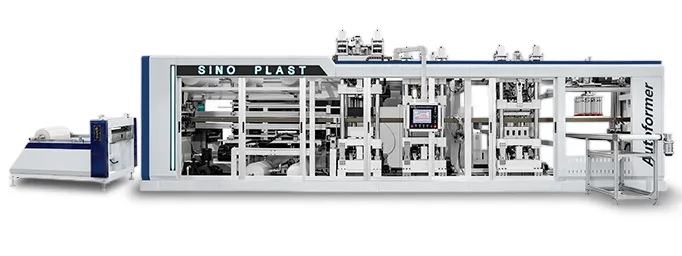
Thermoforming PET and PP requires different approaches because the two materials have fundamentally different properties. The choice affects everything from heating profiles to cycle speeds.
PET (Polyethylene Terephthalate): Clear, strong, and widely used for cold beverage cups, fruit trays, and clear retail packaging. PET has a lower forming temperature (approximately 110°C) compared to PP, which means faster cycles when properly processed. However, PET is hygroscopic — it absorbs moisture from the air and must be pre-dried to prevent surface defects such as smearing during forming.
PP (Polypropylene): Tough, heat-resistant, and increasingly popular for microwaveable containers and hot-drink cups. PP has excellent chemical resistance and can withstand temperatures up to 120°C. It does not require pre-drying, simplifying handling. But PP has a higher forming temperature and a narrower processing window, often resulting in slower cycle speeds.
| Property | PET | PP |
|---|---|---|
| Typical forming temperature | ~110°C | ~200°C |
| Moisture sensitivity | High — requires pre-drying | Low — no drying required |
| Relative cycle speed | Faster (up to 40-45 molds/min) | Slower (typically 25-35 molds/min) |
| Heat resistance | ~70°C (softens above) | ~120°C |
| Transparency | Excellent crystal clarity | Milky/cloudy (clarified grades available) |
| Material density | Higher (more weight per part) | Lower (more parts per kilogram) |
| Processing challenge | Moisture control | Narrower forming window |
Different machine configurations handle these materials with varying efficiency. To see how forming area and servo options affect performance for each material, review the plastic thermoforming machine configurations overview.
Pros and Cons of Thermoforming PET
Faster cycle speeds: PET reaches forming temperature more quickly than PP. A high-speed thermoforming machine can achieve up to 40-45 molds per minute with PET, compared to approximately 25-35 molds per minute with PP on similar equipment.
Superior optical clarity: PET's transparency makes it the material of choice for applications where product visibility matters — fresh produce packaging, cold beverage cups, and premium retail displays. The clarity is inherent to the material, requiring no additives.
Well-established recycling infrastructure: PET is highly recyclable (resin code #1) and has an established supply chain for post-consumer recycled content. Regulatory targets for recycled content in PET packaging are higher than for other plastics, making PET attractive for markets with sustainability mandates.
Consistent part quality when properly processed: When the material is properly pre-dried and processed with precise temperature control, PET produces consistent, strong parts with good impact resistance.
Pre-drying requirement: PET must be dried before processing to remove moisture. Moisture in the sheet causes surface defects such as smearing or bubbling during heating. This adds an equipment cost (dryer) and an additional process step.
Lower heat resistance: PET softens at approximately 70°C, limiting its use to cold-fill applications. It cannot be used for microwaveable containers or hot-drink cups without crystallization (CPET), which requires a different process.
Higher density: PET has a higher density than PP, meaning fewer parts per kilogram of material. For lightweighting initiatives, this is a disadvantage.
Higher material cost per part: The combination of higher density and higher raw material cost (typically) makes PET more expensive per part than PP in many applications.
Heat resistance: PP withstands temperatures up to 120°C, making it suitable for hot-fill applications, microwaveable containers, and dairy packaging that sees warm filling temperatures.
No pre-drying required: PP is not hygroscopic, so it does not require pre-drying equipment or additional processing time. This simplifies the production line and reduces operating costs.
Lower density — more parts per kilogram: PP has the lowest density among common thermoforming polymers. This means significantly more parts per kilogram of raw material, directly reducing material cost per part.
Good chemical resistance and impact strength: PP performs well in contact with food and resists stress cracking, making it suitable for demanding packaging applications.
Living hinge capability: PP is the material of choice for lids and containers that require a hinge that opens and closes repeatedly without breaking.
Recyclable: PP is recyclable (resin code #5), though collection and recycling rates are generally lower than PET.
Slower cycle speeds: PP requires higher forming temperatures and a narrower processing window than PET. As a result, cycle speeds are typically slower — up to 30 molds per minute with PP compared to 40+ with PET. Heating is where a lot of part quality is actually decided, because polymers like PET and PP do not warm evenly; an overheated sheet thins too far, while a cold one will not form at all.
Challenging processing window: PP has a more restrictive forming window than PET. It is considered a "tricky" material that is less stable and forgiving, with a less established processing track record than PET or PS. This requires tighter process control and more precise machine settings.
Lower transparency: Standard PP is milky or cloudy in appearance. Clarified grades can improve transparency, but they do not match PET's crystal clarity.
Higher forming temperature required: PP needs approximately 200°C to form — significantly higher than PET's ~110°C. This means higher heating energy consumption, though this may be offset by PP's lower material density.
The decision between PET and PP influences several machine specifications.
Heating system: PET forms at lower temperatures but requires precise moisture control. PP requires higher heating temperatures and more uniform heating across the sheet. Some machines use advanced heating elements that offer energy savings — for example, ceramic heaters that achieve 10-12% energy savings with PET and 12-15% savings with PP .
Pre-drying capability: Machines running PET require a pre-drying system. PP does not. This affects the equipment configuration and costs.
Temperature control: For PP, the narrower processing window demands more precise temperature control. The forming station must maintain consistent heat across the sheet to avoid thinning or incomplete fills. Machines with multi-zone temperature control and recipe storage are particularly beneficial for PP processing.
Servo precision: A machine with servo-driven forming stations, such as a four-station machine with servo-controlled forming, punching, cutting, and stacking, can optimize the process for both materials. According to ILLIG, recipe storage and precise timing for key forming phases are essential for accurate, repeatable settings, especially when working with materials that have narrow processing windows. This applies equally to PP as to PET.
Maximum speed: If you primarily run PET, you may prioritize maximum speed (40+ molds/min). If you run PP or a mix of materials, a machine designed for consistent quality at moderate speeds may be more appropriate than one pushing the speed limit.
Different products — cups, lids, trays — have different material requirements. For an overview of which applications suit each material, see Sinoplast plastic cup machines and thermoforming machines applications.
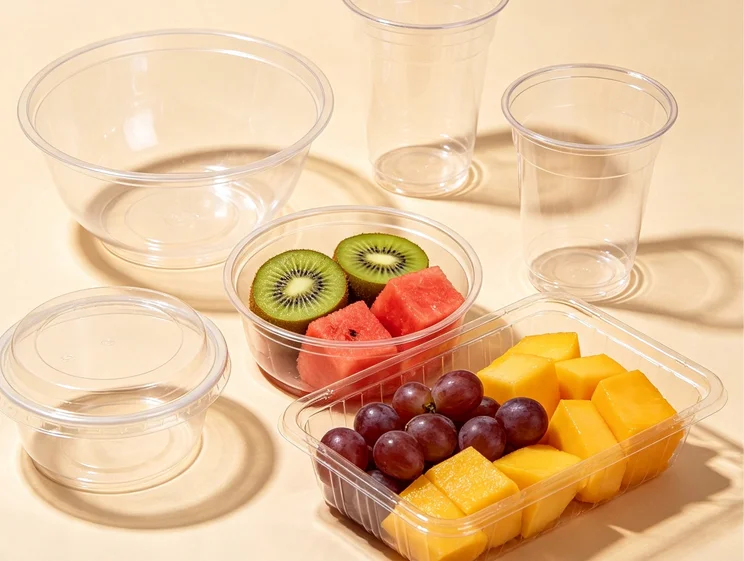
Use this framework to evaluate which material — and therefore which machine configuration — fits your production needs.
Cold drinks, ambient storage → PET is suitable
Hot drinks, microwave reheating, hot-fill → PP is required
If your product sees temperatures above 70°C, PP is the appropriate choice
Crystal clarity essential (branding, premium packaging) → PET
Clarity not critical → PP acceptable; clarified PP grades available
Maximizing parts per hour → PET runs faster; cycle times are shorter
Heat resistance more important than speed → PP remains viable despite slower cycles
PET: Higher density, higher raw material cost → fewer parts per kilogram
PP: Lower density, often lower raw material cost → more parts per kilogram
This difference can offset PP's slower cycle speed in many applications
EU markets: Higher recycled content targets for PET (30% by 2030) than for PP (10% by 2030 for non-PET packaging)
Markets without strict mandates: Both materials viable
A manufacturer produces 2 million clear cups per month for a national juice chain. The product is cold-filled. Transparency is essential for branding.
Material fit: PET is the appropriate choice. The machine can run PET at up to 40-45 molds per minute, maximizing output. The crystal clarity meets brand requirements. The company must invest in a pre-drying system, but the faster cycles and premium product positioning justify the additional equipment.
Machine considerations: A high-speed machine with precise temperature control and in-mold cutting produces consistent thin-wall PET cups. The system should include an integrated dryer for the sheet supply.
A manufacturer produces microwaveable meal trays and yogurt cups for a European retailer. Products require heat resistance for hot-fill and reheating.
Material fit: PP is the appropriate choice. The heat resistance (up to 120°C) matches the application requirement. The lower density means more parts per kilogram, partially offsetting the slower cycle speed.
Machine considerations: A machine with robust temperature control and a rigid frame structure maintains consistent quality during PP processing. The tighter processing window demands precise heating and forming control. Machines with recipe storage and quick-change capabilities reduce changeover time between different PP products.
A packaging converter produces both cold beverage cups (PET) and hot food trays (PP). Monthly volume is split 50/50.
Material fit: Neither single material covers both applications. The converter needs either two production lines — one optimized for PET, one for PP — or a single line that can switch between materials, accepting the speed and quality trade-offs.
Machine considerations: A machine with recipe storage for different materials reduces downtime between changeovers. Modern machines with PLC control and touch screens allow precise time settings and parameter storage, enabling quick recall of proven settings for each material and mold combination. This makes mixed-material production more practical.
You now have a framework for choosing between PET and PP thermoforming based on your product requirements, speed priorities, and cost structure:
PET offers faster cycle speeds, superior clarity, and established recycling infrastructure — but requires pre-drying and cannot handle heat
PP offers heat resistance, no drying requirement, lower density, and good chemical resistance — but runs slower and has a tighter processing window
The decision is not about which material is "better" but which fits your specific production profile. A machine that is ideal for PET may not be optimal for PP, and vice versa.
Once you have determined whether PET, PP, or both suit your product line, comparing specific machine features — heating zone configuration, servo precision, temperature control systems, and maximum forming area — becomes the logical next step for selecting equipment that matches your primary material.
PET Sheet Pre-Drying Requirements: Why Moisture Control Matters
Heating Profile Optimization for PET vs PP Thermoforming
Material Yield Comparison: How Density Affects Cost Per Container
How Forming Area and Cavity Count Affect Material Utilization
Regrind Integration: Managing Recycled Content in PET and PP Thermoforming
Sep 01,2026
We are a professional plastic machinery provider in China.